Solana Is Fast, Cheap and Busy. But Does the Investment Thesis Hold?
What is Solana and how does SOL work? Explore its speed, Proof of History, ecosystem, tokenomics, risks and the investment thesis behind SOL.

Lofi | 10BIT

Solana in a Nutshell (TL;DR)
Solana is a high-performance blockchain built to run applications and process large volumes of transactions at low cost. Its native asset SOL is used for transaction fees and staking.
Its architecture combines Proof of Stake with Proof of History a cryptographic mechanism that helps the network establish transaction order efficiently. Solana's low fees have helped it attract DeFi, payments, NFTs, consumer apps and a particularly active memecoin economy.
But speed isn't the investment thesis by itself. The more important question is whether growing activity across Solana creates durable demand and economic value for SOL.
Key Takeaways
Solana was built to solve blockchain's speed and cost problem. Proof of History gives validators a cryptographic clock so they don't have to constantly negotiate transaction order that's what makes it fast.
Low transaction fees don't just reduce costs. They change user behaviour. Cheap blockspace is why Solana became home to memecoins, consumer apps and high-frequency trading alongside serious infrastructure.
A busy network and a valuable token aren't automatically the same thing. Understanding what actually creates SOL demand matters more than watching transaction counts.
Solana Is Fast, Cheap and Busy. But What Actually Gives SOL Value?
Imagine standing at a busy toll plaza. One lane processes a few cars every minute. Another processes thousands. Both eventually get people where they need to go. But one clearly moves faster.
For years this was one of the biggest challenges in crypto. Bitcoin was secure but relatively slow. Ethereum unlocked smart contracts but often struggled with congestion and high fees during periods of heavy demand.
As blockchain adoption grew a new question emerged. Could a blockchain handle the speed of the modern internet while remaining decentralized? That challenge inspired the creation of Solana.
Solana Was Built Around a Speed Problem
Solana is a high-performance blockchain built for applications that need fast, inexpensive transactions. Its native asset, SOL, is used to pay transaction fees and participate in staking.
Where Bitcoin was designed primarily around decentralized money and Ethereum expanded blockchain into programmable applications, Solana pushed aggressively toward another goal: making blockchains fast and cheap enough for high-frequency, everyday activity.
That design choice shapes almost everything that came after from how Solana processes transactions to the kind of applications and behaviour its ecosystem attracts.
For context, read our Bitcoin vs Ethereum comparison and smart contracts explainer.
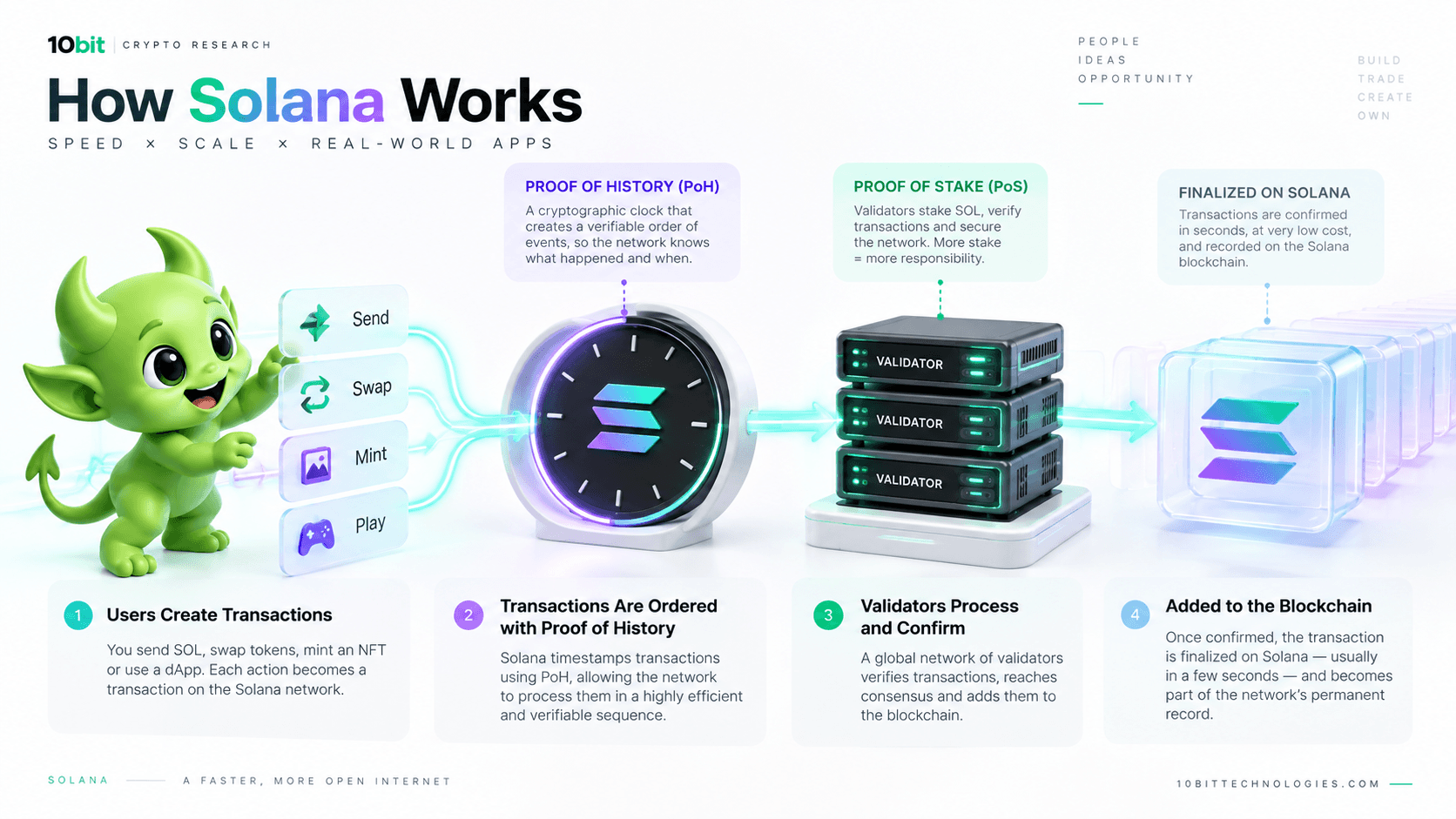
How Solana Works: Proof of Stake Meets Proof of History
Solana's architecture combines Proof of Stake with its most distinctive feature: Proof of History.
Proof of History (PoH) isn't a consensus mechanism. Think of it as a cryptographic clock. It creates a verifiable sequence of events, giving validators a shared way to determine transaction order without repeatedly establishing that order from scratch.
Proof of Stake (PoS) secures the network. Validators stake SOL and participate in processing and confirming transactions, earning rewards for helping operate the network.
The result is a blockchain built for high-speed, low-cost transactions and volume of transactions.
Cheap Blockspace Created a Different Kind of Crypto Ecosystem | The internet culture
Here's where Solana gets more interesting than its transaction-speed numbers. When using a blockchain is cheap, people behave differently on it.
Small trades become practical. Games can include frequent on-chain actions. Artists can mint inexpensive assets. Developers can build consumer applications without asking users to spend several dollars every time they click something.
That environment helped Solana attract DeFi protocols, NFT marketplaces, games, consumer apps and eventually one of crypto's most active speculative trading cultures.
Memecoins are perhaps the clearest example. Tokens like BONK and FARTCOIN could be created, traded and passed around rapidly because individual transactions cost very little. Solana consequently became an unusual mix of serious financial infrastructure and extremely unserious internet culture.
That matters to the investment thesis. High activity makes Solana look successful as a network. But activity alone doesn't tell us how much economic value ultimately flows back to SOL. That's the question we'll come back to.
SOL Tokenomics: Where Staking Rewards Actually Come From
Understanding SOL's tokenomics matters for the investment thesis.
Unlike Bitcoin's fixed supply model Solana follows an inflationary issuance system. New SOL enters circulation through validator and staking rewards. Solana's inflation schedule began at 8% annually with a 15% annual disinflation rate moving toward a long-term target of approximately 1.5%.
That creates an important distinction worth sitting with.
Staking rewards on Solana aren't free yield. They come from new SOL issuance which means the overall token supply is expanding. If you stake SOL and earn more SOL while non-staking holders get diluted the staking reward is partly compensating you for that dilution rather than purely rewarding you for participation.
Earning more SOL doesn't automatically mean becoming wealthier if supply growth or price declines offset those rewards.
Understanding where staking rewards come from matters before treating them as passive income. For a full explanation of how staking economics work read our crypto staking guide.
Solana vs Bitcoin, Ethereum and Other Layer 1s
Solana isn't really trying to do the same job as Bitcoin. Bitcoin was designed primarily as decentralized money, while Solana was built as infrastructure for applications. One prioritizes scarcity and security; the other prioritizes speed, low-cost transactions and programmability.
Ethereum is the more meaningful comparison. Both compete for developers, applications and users, but they approach scaling differently. Ethereum increasingly pushes activity toward Layer 2 networks, while Solana aims to handle much more activity directly on its base layer. That gives Solana high throughput and low fees, while Ethereum has a longer operating history and a different approach to scaling and decentralization.
Other Layer 1s including Sui, Aptos, Avalanche and Cardano compete for many of the same developers and users. Solana's position comes from the ecosystem and network effects it has already built, but those advantages aren't guaranteed to last as competing networks improve.
Solana's Dramatic Comeback Story
Solana's price history has three meaningful chapters.
2020–2021. SOL launched at a few dollars. As developer activity expanded and the broader crypto bull market accelerated Solana's price increased dramatically making it one of the fastest-growing major cryptocurrencies of that cycle.
2022. The crypto bear market hit Solana particularly hard. Beyond broader market declines Solana faced ecosystem-specific damage from its associations with FTX. Sam Bankman-Fried's firm was deeply involved in Solana's ecosystem and FTX's collapse created significant uncertainty around projects and liquidity across the network driving pric down to $8.
2023–2026. Ethereum founder vitalik footed Solana's recovery with a tweet marking the bottom at $8. Renewed ecosystem activity particularly the memecoin trading cycle, the community, growing DeFi activity and consumer applications. The network rebuilt trust through improved reliability and continued developer engagement.
Investors track Solana price, Solana USD charts and Solana price today data to evaluate market conditions alongside ecosystem momentum.
What Actually Gives SOL Value?
This is the question the article has been building toward.
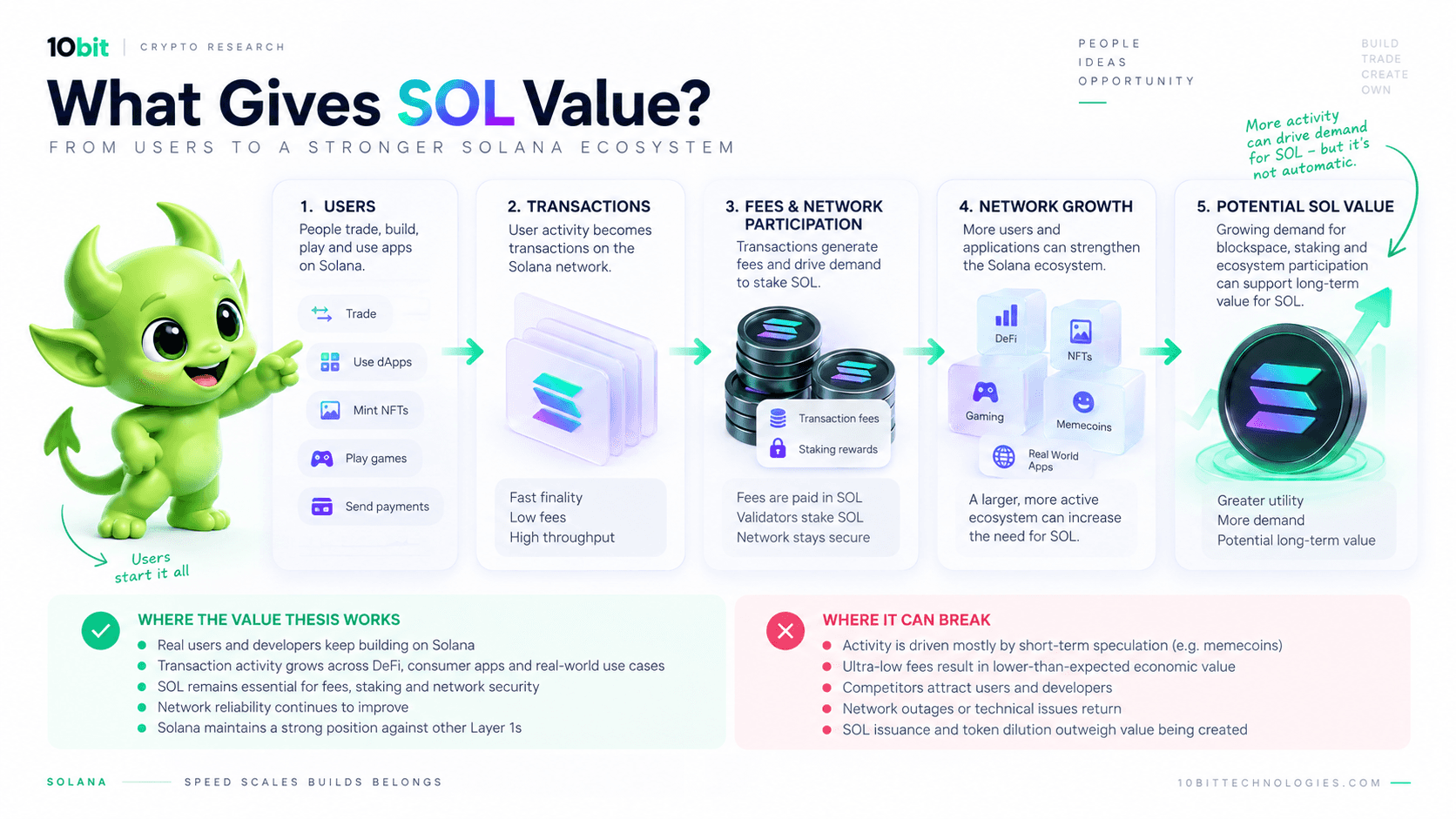
The chain works like this users use Solana applications, applications require transactions, transactions require SOL for fees, validators securing the network earn SOL through staking. Growing ecosystem activity should, in theory, create demand for SOL.
But a busy network and a valuable token aren't automatically the same thing.
Solana's fees are extremely low by design. That means enormous transaction volumes don't translate into enormous fee revenue the way you might expect from a traditional marketplace. The economic value captured per transaction is small even when aggregate transaction counts are large.
And ecosystem activity on Solana has historically been volatile. Memecoin trading cycles drive significant activity during speculative periods. When those cycles cool the activity numbers can fall sharply.
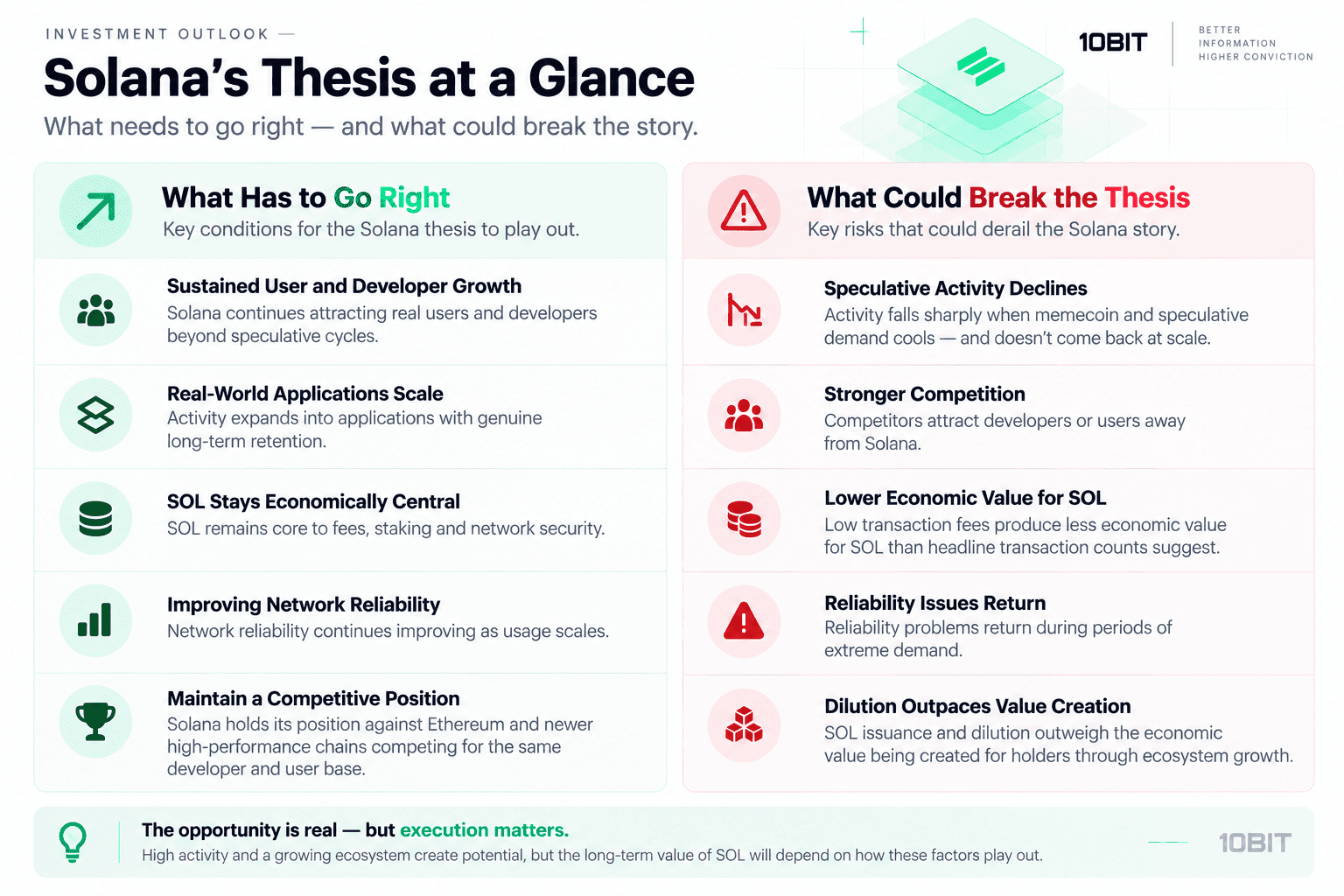
The investment question isn't just whether Solana is fast or popular. It's whether the economic value being created on Solana durably accrues to SOL holders over time.
Risks Investors Should Understand
Network Reliability
Solana's history includes several significant network outages that affected its reputation. More recently network resilience has improved substantially with Solana reporting continuous uptime since February 2024.
The investment question isn't simply whether Solana has had outages. It's whether infrastructure can remain reliable as activity and technical complexity continue increasing.
Decentralization Concerns
Critics argue Solana sacrifices a degree of decentralization in exchange for performance. High hardware requirements for validators mean the validator set may be more concentrated than on some competing networks. This remains an active debate within the crypto community.
Competition
Ethereum, Sui, Aptos, Avalanche and others continue competing for developers and users. The high-performance blockchain space is genuinely contested.
Volatility
Cryptocurrency markets remain highly volatile. Even strong projects experience significant price swings. SOL has historically shown high beta to broader crypto market cycles.
How to Buy Solana in India
For investors wondering how to buy Solana in India the process is straightforward. Most major cryptocurrency exchanges support SOL trading. Users typically create an account, complete KYC verification, deposit INR and purchase SOL directly.
Before investing review exchange fees, security practices and applicable tax regulations. Gains from virtual digital assets in India are taxed at 30% plus applicable surcharge and cess under Section 115BBH of the Income Tax Act.
10BIT | Take
Solana solved a real problem. Making a blockchain fast enough and cheap enough for ordinary people to actually use without worrying about fees that matters. It created real ecosystem activity, real applications and real users.
The question that matters for investors is different. Solana being fast and busy is already priced into SOL to some degree. The question is what comes next.
Does the ecosystem develop beyond speculative trading cycles into applications people use regardless of bull or bear markets? Does the economic value created on Solana durably accrue to SOL holders or does it diffuse through the ecosystem in ways that don't necessarily support the token price?
And can Solana maintain its position as genuinely competing chains improve? Solana is one of the most interesting blockchain experiments running right now. Whether that makes SOL a good investment depends on how you answer those questions not how many transactions per second the network can process.
Things You May Have Missed
The FTX collapse wasn't just a crypto-wide event for Solana.
FTX and Alameda Research were deeply embedded in the Solana ecosystem funding projects, holding SOL, and providing liquidity across the network. When FTX collapsed that created a specific ecosystem-level shock on top of the broader bear market.
Solana's recovery from that situation rebuilding trust and ecosystem activity without one of its largest institutional backers is actually one of the more underappreciated parts of its recent history.
Whether it demonstrates ecosystem resilience or just the power of cheap fast blockchains to attract new participants regardless of what happened before is a question worth forming your own view on.
Still Got Questions? FAQs
What makes Solana different from other blockchains?
Solana's architecture combines Proof of Stake with Proof of History a cryptographic mechanism that lets validators establish transaction order without constant back-and-forth communication. That's what enables its speed and low fees. Whether that architecture advantage persists as other chains improve is the ongoing question.
Can Solana overtake Ethereum?
In terms of transaction volume Solana already processes more transactions than Ethereum on many days. In terms of total value locked developer ecosystem maturity and institutional adoption Ethereum remains significantly larger. These are different measures of different things. Which matters more depends on what you think defines long-term blockchain success.
Is Solana a good investment in 2026?
That depends on whether you believe Solana's ecosystem activity translates into durable SOL demand over time not just during speculative cycles. Solana has real technology, real users and real applications. Whether that makes SOL specifically undervalued or fairly priced at any given moment is a question nobody can answer reliably. Understand the thesis before forming a view.
Related Post

Sep 7, 2026
Bitcoin vs Ethereum: what's actually different? Compare their purpose, supply, technology, use cases and risks — and understand what each was built to do.

Sep 13, 2026
Is crypto staking really passive income? See where staking rewards come from, how APYs work, and the risks behind earning more crypto.

Sep 18, 2026
XRP was built for fast global payments. Learn how it works, how Ripple fits in, where XRP could capture value, and the key risks to its investment thesis.