Bitcoin vs Ethereum: Key Differences Explained | 10bit
Bitcoin vs Ethereum: what's actually different? Compare their purpose, supply, technology, use cases and risks — and understand what each was built to do.

Lofi | 10BIT

Bitcoin vs Ethereum in a Nutshell (TL;DR)
Bitcoin and Ethereum are the two largest cryptocurrencies by market value. They are also two completely different ideas.
Bitcoin is primarily trying to be money. A scarce, decentralised digital asset with a fixed supply that nobody can inflate away.
Ethereum is primarily trying to be infrastructure. A programmable blockchain where developers build applications, financial products and digital economies.
People compare them constantly. The more useful question is what each was actually built to do and which idea you think matters more.
Key Takeaways
1. Bitcoin and Ethereum weren't built to do the same job. Comparing them as if they're two versions of the same thing is where most beginners go wrong.
2. Bitcoin's big idea is digital scarcity. Ethereum's big idea is programmable blockchain infrastructure. Both ideas can succeed at the same time.
3. The better question isn't which coin is better. It's which idea you're actually betting on and what would make that bet wrong.
Crypto loves turning everything into a horse race.
Bitcoin vs Ethereum. Which one wins. Which one goes higher. Which one should you buy.
But here's the thing most beginners miss early on Bitcoin and Ethereum were not built to do the same job. They are not two versions of the same product competing for the same market. They represent two different ideas about what blockchain technology should become.
And once you understand that distinction everything else in this comparison becomes significantly easier to follow.
If Bitcoin itself still feels confusing, start with how Bitcoin actually works. For the technology underneath both networks, here's how blockchain networks work.
Bitcoin and Ethereum in 60 Seconds
Before diving into differences here is what each actually is.
Bitcoin launched in 2009 proposing a peer-to-peer electronic cash system that didn't require a trusted financial intermediary. Its protocol limits total issuance to approximately 21 million BTC. Over time its scarcity and monetary properties led many investors to treat it as a store of value, hence the digital gold comparison.
Ethereum launched in 2015 designed as a programmable blockchain. Its native asset ETH is used within a network where developers can build smart contracts and applications. Where Bitcoin focused on being money Ethereum focused on being a platform.
The simplest distinction -
Bitcoin is primarily trying to be money.
Ethereum is primarily trying to be infrastructure.
That's an oversimplification. But it's a much better starting point than assuming they're two versions of the same thing.
Bitcoin vs Ethereum: What Actually Differs?
This distinction will save you from a very expensive mistake.
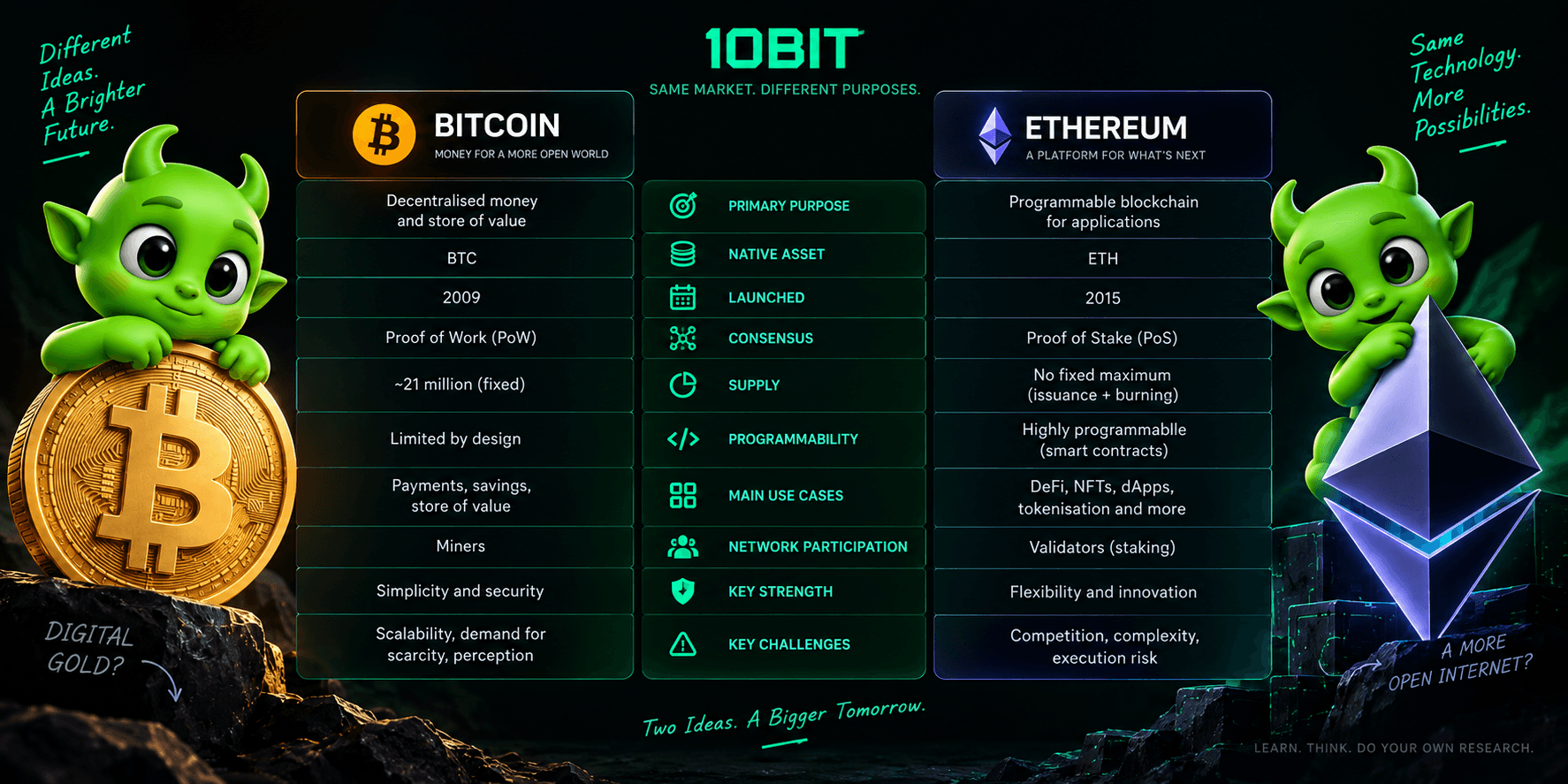
The table above covers the core differences. Here's what actually matters behind each one.
Purpose
Bitcoin was designed as decentralised peer-to-peer money and is now widely treated as a scarce digital store of value. Its intentional simplicity is a feature, not a limitation.
Ethereum is designed to be a programmable platform. Developers build decentralised applications, financial protocols, NFT infrastructure and more on top of it.
This is the most fundamental difference. Bitcoin focuses on what it is. Ethereum focuses on what you can build with it.
Technology and Consensus
Bitcoin uses proof of work. Miners use computational power to validate transactions and secure the network. This process requires significant energy but makes Bitcoin extremely secure and battle-tested.
Ethereum transitioned from proof of work to proof of stake in 2022. Instead of miners the network uses validators who lock up ETH to help validate transactions. This reduced Ethereum's estimated energy consumption by more than 99%.
Supply
Bitcoin's monetary policy is relatively straightforward. New BTC issuance declines over time through halvings with total issuance designed to approach roughly 21 million. Changing that would require the network to accept a fundamentally different set of rules.
Ethereum has no fixed maximum supply. New ETH is issued to validators while part of transaction fees is permanently removed from circulation through burning under EIP-1559. That means Ethereum's supply can grow or shrink depending partly on network activity and issuance.
Bitcoin makes scarcity predictable. Ethereum makes supply dynamic.
Programmability
Bitcoin is intentionally limited in what you can build on it. That limitation is deliberate — it prioritises security and simplicity over flexibility.
Ethereum is highly flexible. Smart contracts allow developers to build complex applications directly on the blockchain. This opened the door to decentralised finance, NFTs, gaming economies and more.
Use Cases
Bitcoin is primarily used as a store of value and a hedge against currency debasement. Its predictable supply is one reason supporters argue it could serve as a long-term store of value. That doesn't mean Bitcoin reliably rises whenever consumer price inflation rises.
Ethereum powers an entire ecosystem. In DeFi users can lend, borrow and earn yield without banks. In NFTs artists can issue and sell digital assets. In blockchain games, players can hold and trade tokenised in-game assets.
Ethereum enables use cases that go far beyond simple payments.
Why Do Bitcoin and Ethereum Sometimes Move Together?
Because markets don't price assets based only on technology. They run on human emotions and behaviour.
Bitcoin and Ethereum exist inside the same crypto liquidity environment. When investors become more willing to take crypto risk capital can flow into both. When fear takes over both can sell off.
But their narratives can diverge.
Bitcoin can react to changes in institutional demand, monetary expectations or its role as a scarce asset. Ethereum can react to network usage, staking economics, application activity and competition from other smart contract platforms.
Different assets can still be driven by the same humans.
Understanding why crypto prices can be so volatile helps explain why both move as dramatically as they do. And understanding how crypto market cycles work explains the broader context in which both operate.
Bitcoin or Ethereum: Which One Makes More Sense?
There's no objective winner because they're trying to do different things.
If you're evaluating Bitcoin you're largely asking whether a scarce decentralised digital asset can continue earning trust as money and a store of value.
If you're evaluating Ethereum you're asking something different — whether a programmable blockchain can remain important infrastructure for applications, financial activity and digital assets. And whether ETH continues capturing value from that ecosystem.
Those are different investment theses. And they come with different ways of being wrong.
Bitcoin could struggle if demand for its monetary properties weakens, regulation constrains access or competing systems reduce its relevance.
Ethereum has those broader crypto risks plus execution risk — competing blockchains, changing network economics, application migration and the complexity of scaling a programmable ecosystem.
The better question isn't which coin wins. It's which idea you're actually betting on.
Risks and Considerations
The part nobody talks about honestly enough.
Volatility
Both assets have experienced sharp price swings. Drops of over 50% are not uncommon in crypto markets. Neither Bitcoin nor Ethereum is immune to this.
Technology Risk
Bitcoin faces scalability limitations on its base layer. Solutions exist but they add complexity. Ethereum faces challenges including network congestion, transaction fees during peak demand and competition from other smart contract platforms. Improvements are ongoing but the ecosystem is more complex to maintain.
Competition
Bitcoin's biggest challenge isn't another Bitcoin. It's whether enough people continue believing that digital scarcity is worth paying for. Ethereum's challenge is more conventional competition. Solana, Sui and other smart-contract networks are competing for developers, users, applications and capital.
10BIT | Take
Bitcoin and Ethereum are the two names everyone compares even though they weren't really built to do the same job.
Bitcoin's big experiment is whether digital scarcity can become durable money.
b. Ethereum's big experiment is whether blockchains can become infrastructure people actually build economies on.
Both experiments could succeed. Both could disappoint. And one succeeding doesn't automatically require the other to fail.
Bitcoin asks whether we need a new kind of money.
b. Ethereum asks what else we can build once money becomes programmable.
That's a much more interesting comparison than staring at two price charts.
Things You May Have Missed
Owning ETH is not the same thing as owning Ethereum. Ethereum is the network. ETH is its native asset.
The distinction sounds pedantic until you realise the same principle applies across crypto a useful blockchain does not automatically tell you how its token captures value. A network can be successful while the investment thesis around its token is more complicated.
Worth understanding before you start analysing any other altcoin.
Still Got Questions? FAQs for you
Is Ethereum better than Bitcoin?
Neither is objectively better because they were designed for different purposes. Bitcoin primarily focuses on digital money and scarcity. Ethereum is a programmable blockchain designed to support smart contracts and applications.
Better depends entirely on what you're trying to do.
Can Ethereum ever overtake Bitcoin in market value?
It's possible. Crypto markets call that hypothetical the flippening. But it is unlikely to happen as the market leader stands at Bitcoin.
Whether it happens depends on adoption, institutional behaviour and how each ecosystem develops. More importantly, market cap alone wouldn't make them equivalent they serve different purposes regardless of price.
Why does Bitcoin have a fixed supply but Ethereum doesn't?
Bitcoin's protocol limits total issuance to roughly 21 million BTC.
Ethereum has no fixed maximum. New ETH is issued to validators while part of transaction fees is burned making its supply dynamics dependent on both issuance and network activity.
Bitcoin makes scarcity predictable. Ethereum makes supply dynamic.
Related Post

Aug 10, 2026
Bitcoin didn't just create digital money. It removed the middleman completely. Here's what it actually is, how mining works, and why it still matters in 2026.

Aug 3, 2026
What is blockchain? Learn how blockchain works, why it matters, and how it's used beyond cryptocurrency with simple examples anyone can understand.

Sep 5, 2026
Learn how altcoins differ from Bitcoin, the major types, examples, risks, Bitcoin dominance and what an altcoin season actually means.