What Are Altcoins? Types, Examples, Risks & Altcoin Season | 10bit
Learn how altcoins differ from Bitcoin, the major types, examples, risks, Bitcoin dominance and what an altcoin season actually means.

Lofi | 10BIT

Altcoins in a Nutshell (TL;DR)
Altcoins are cryptocurrencies other than Bitcoin. That includes everything from Ethereum and Solana to stablecoins, DeFi tokens and meme coins.
The problem is that these assets can have completely different purposes, technologies and risks. Calling something an “altcoin” tells you what it isn't Bitcoin but very little about what it actually is.
That's the part worth understanding.
Key Takeaways
1. Altcoin is a broad term for cryptocurrencies other than Bitcoin, although Ethereum and stablecoins are sometimes treated separately depending on context.
2. Altcoins aren't one type of investment. Ethereum, USDT and Dogecoin can all fall under the same broad label while doing completely different things.
3. Altcoins can rise much faster than Bitcoin during speculative markets — but the same characteristics that create bigger upside can also create much bigger downside.
Bitcoin gets most of the attention.
But look beyond Bitcoin and crypto gets weird very quickly.
Ethereum is trying to be infrastructure for applications. Solana competes for blockchain activity. Stablecoins are designed to barely move in price. Meme coins can become worth billions largely because enough people on the internet decide they matter.
Somehow, all of these can end up under the same label: Altcoins.
That's useful if you need a quick way to separate Bitcoin from everything else. It's much less useful if you're trying to understand what you're actually buying.
Because an altcoin isn't really a type of cryptocurrency in the way a stablecoin or meme coin is. It's more like an enormous box marked: “NOT BITCOIN.” And inside that box are thousands of completely different experiments.
If Bitcoin itself still feels confusing, start with how Bitcoin actually works.
Everything Except Bitcoin Is an Altcoin. That's Where It Gets Messy.
The simple definition is: An altcoin is a cryptocurrency other than Bitcoin. The name comes from “alternative coin.” Bitcoin came first, and the cryptocurrencies that followed were alternatives to it.
Early altcoins often tried to change something about Bitcoin — transaction speed, mining, privacy or how coins were issued. Then Ethereum arrived and expanded the idea considerably.
A blockchain didn't have to exist only to transfer a currency. It could run smart contracts and applications too. That opened the door to DeFi, NFTs, blockchain games, governance tokens and eventually thousands of other crypto projects.
Today, Ethereum, Solana, XRP and Cardano are all commonly described as altcoins. So are Dogecoin and PEPE. Under the broadest definition, so are USDT and USDC. That's why the word gets messy. The important thing isn't how many altcoins exist. It's how few actually matter and how different the ones that do matter can be.
Wait, Is Ethereum Really an Altcoin?
Technically, yes. Under the original and broadest definition, anything other than Bitcoin is an altcoin. But crypto has changed considerably since that term was created.
Ethereum became an enormous ecosystem of its own, so you'll sometimes see traders separate the market into Bitcoin, Ethereum and altcoins.
Stablecoins are also frequently separated when people talk about altcoin performance because a token designed to stay around $1 obviously isn't trying to outperform Bitcoin in the same way Solana or Dogecoin might.
So there isn't some crypto police department deciding what counts.
For this article, we're keeping it simple: Bitcoin is Bitcoin. Everything else can broadly be described as an altcoin but that doesn't make everything else comparable.
Types of Altcoins
This is where the label starts falling apart.
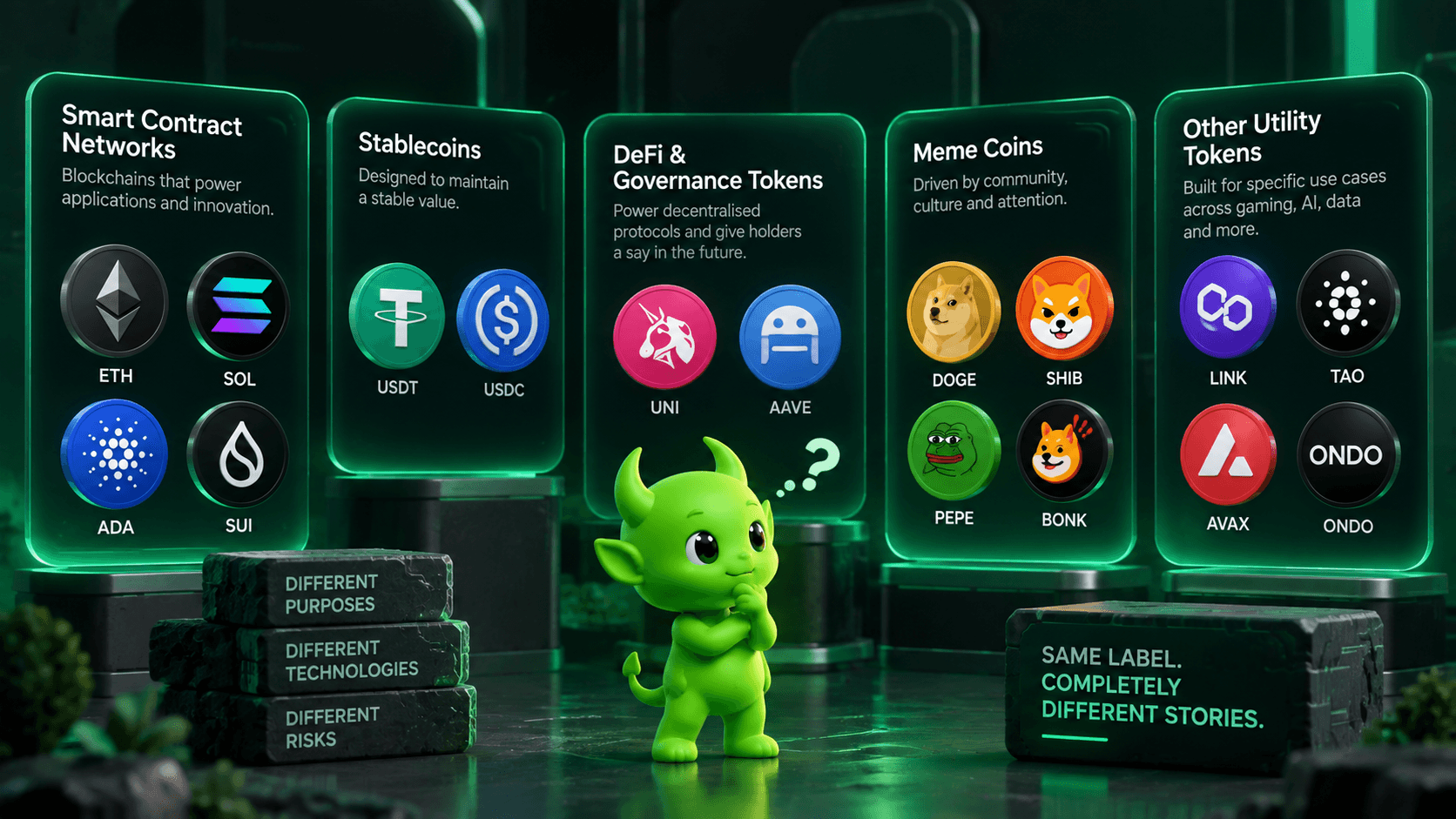
Everything Else
Gaming tokens. AI tokens. Data tokens. Privacy coins. Exchange tokens. Tokens representing real-world assets.
Crypto keeps inventing new categories faster than anyone can create neat boxes for them. It is like one big startup ecosystem. Some survive by value rest fall in line with the next big fools theory in order to just scam people.
And individual tokens can fit into more than one category anyway.
That's why researching an altcoin should begin with "What does this thing actually do?” Not: “How much does one coin cost?”
We'll come back to that second mistake later.
Why Do Altcoins Exist in the First Place?
Because Bitcoin wasn't designed to do everything. And that's not necessarily a criticism of Bitcoin. Bitcoin introduced a way of transferring and holding digital value without relying on a traditional central intermediary. Its design deliberately prioritises certain properties.
Other developers wanted to experiment.
What if a blockchain could run programs? Ethereum.
What if blockchain applications could operate much faster and more cheaply? Networks such as Solana.
What if a crypto asset could track the dollar? Stablecoins.
What if ownership of a token could give users voting rights over a protocol? Governance tokens.
What if a cryptocurrency was basically an internet joke that people collectively decided had value? Well... Dogecoin answered that one.
Crypto is essentially a giant ongoing experiment in what digital assets and blockchain networks can be used for. Most experiments won't matter forever.
Some already do. And figuring out the difference is considerably harder than finding the ticker on an exchange.
Why Can Altcoins Go Up So Much Faster Than Bitcoin?
This is where human behaviour enters the picture.
Bitcoin is enormous. A huge amount of buying pressure is required to move an asset with a very large market capitalisation.
Smaller altcoins don't have the same problem. Less capital can create much larger percentage moves. And once those moves begin, something predictable happens.
People notice. Bitcoin rises 20%. A smaller altcoin rises 80%. Suddenly 20% doesn't feel exciting anymore.
Traders start moving further out on the risk curve looking for the next asset capable of doubling, tripling or doing something even more ridiculous like fartcoin or memecoins lol.
Higher potential returns attract risk-taking.
Risk-taking pushes prices higher.
Higher prices attract attention.
Attention attracts more buyers.
For a while, the loop can feed itself. Then sentiment changes.
And everything that made the asset capable of moving violently upward, smaller size, thinner liquidity, speculative holders, can help it move violently in the other direction.
The reason altcoins can outperform Bitcoin is closely connected to the reason they can absolutely wreck you.
So What Is Altcoin Season?
Crypto eventually gave this behaviour a name: Altseason.
Altcoin season describes a period when a broad portion of the altcoin market is outperforming Bitcoin.
One thing traders watch is Bitcoin dominance—Bitcoin's market capitalisation as a percentage of the overall crypto market. If Bitcoin dominance is falling while a broad range of altcoins are rising, it can suggest that attention and capital are moving further out across the crypto market.
But here's where people oversimplify it:
Bitcoin dominance falling does not automatically mean altseason. Stablecoin supply can affect dominance. Bitcoin itself can fall. Different parts of the market can move for completely different reasons.
There isn't one magic chart that flashes: ALTSEASON STARTS NOW.
One popular measure is BlockchainCenter's Altcoin Season Index. Its methodology considers it altcoin season when 75% of the top 50 eligible cryptocurrencies have outperformed Bitcoin over the previous 90 days, excluding stablecoins and asset-backed tokens.
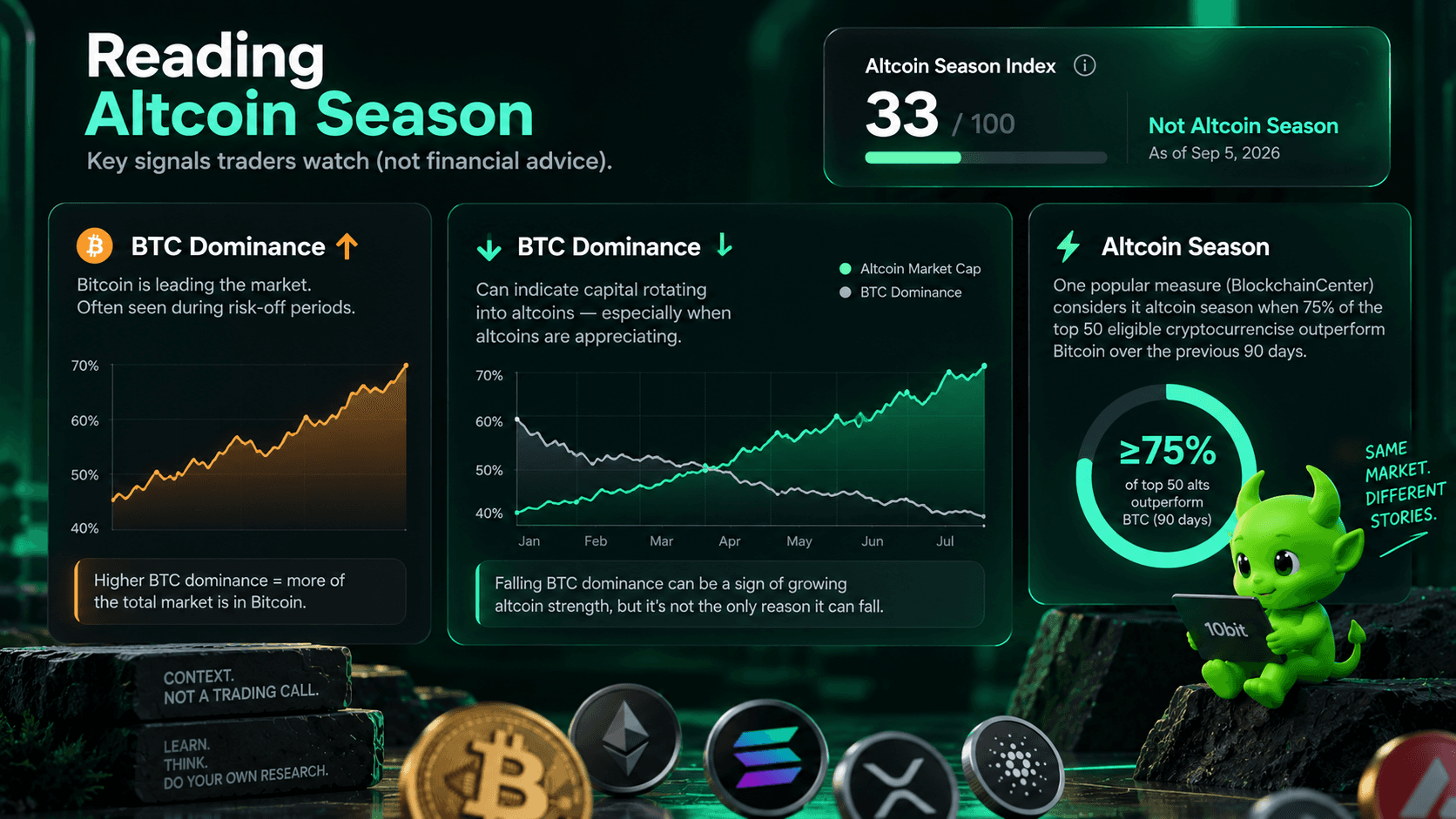
The useful thing isn't treating any of these indicators as a trading signal.
It's understanding what they're trying to measure: Where is the market willing to take risk? That's also why crypto market cycles matter.
The Part About Altcoins Nobody Likes Talking About
Everyone likes discussing the altcoin that went up 20x. The thousands that disappeared are less exciting.
Smaller Coins Can Move Brutally Fast
The volatility works both ways. A smaller asset can rise 100% much more easily than Bitcoin. It can also lose 70%, 80% or 90% of its value with frightening speed.
If those kinds of moves seem absurd, understanding why crypto prices become so volatile helps explain what's happening underneath them.
Sometimes There Isn't Enough Liquidity
A price on a screen doesn't guarantee you'll actually be able to sell a large amount at that price. Smaller tokens can have thin markets.
When everyone tries to exit simultaneously, buyers can disappear, and the price required to find the next buyer can fall rapidly.
More Tokens Can Be Coming
This one catches beginners constantly. Imagine a project has 100 million tokens circulating today. But eventually one billion tokens can exist.
Those future tokens might belong to teams, early investors, foundations or incentive programmes and may gradually unlock over time. So even if demand stays the same, supply can change dramatically.
Token price alone doesn't tell you that.
Some Projects Are Just Bad
Crypto makes creating a token relatively easy. Creating something people genuinely need is much harder.
A professional website, active X account and complicated whitepaper do not automatically create a useful project.
Some altcoins fail because the idea doesn't work.
Some because nobody uses them.
Some because funding disappears.
Some because the team disappears.
And some were never particularly serious to begin with.
Hype Can Become the Product
Sometimes people buy an asset because they believe in the technology. Sometimes they buy because they think somebody else will pay more tomorrow. The difficult part is recognising which one you're looking at.
Crypto contains plenty of both.
10BIT | Take
“Altcoin” might be one of crypto's least useful useful words. It tells you exactly one thing about an asset: It isn't Bitcoin. That's it.
It doesn't tell you whether you're looking at infrastructure used by millions of people, a token designed to track the dollar, a vote in a financial protocol, an internet meme or something created last Tuesday.
Yet exchanges put all of them on the same screen. They all get tickers. They all get prices. And suddenly they start looking more comparable than they really are.
That's where beginners get caught. Because the easiest question in crypto is:
“Can this coin go up?” Almost anything can go up.
The harder questions are:
What does it actually do?
Why does the token need to exist?
Who owns the supply?
Who actually uses it?
And what would make people still care about it five years from now?
The ticker is the easy part.
Understanding what's underneath it is the investment.
Things You May Have Missed
Here's one of the easiest psychological traps in crypto: “This coin only costs $0.10. Imagine if it reaches Bitcoin's price.”
No. That's not how it works. A coin costing $0.10 can already be more expensive — in valuation terms — than a coin costing $1,000.
Why? Because the number of tokens matters.
If a cryptocurrency has 10 billion coins circulating at $1 each, its market capitalisation is $10 billion.
If another has only 1 million coins circulating at $1,000 each, its market capitalisation is only $1 billion.
The $1 coin is actually valued ten times higher as a network despite looking “cheaper” on your screen. That's why price per coin is nearly meaningless without supply.
Cheap-looking isn't the same thing as cheap. Remember that the next time someone tells you a $0.02 token “only needs to reach $1.”
Related Post

Sep 4, 2026
What are stablecoins and why do they matter? Learn how USDT, USDC and crypto-backed stablecoins maintain their pegs, how they're used and what can go wrong.

Jul 24, 2026
Learn how crypto market cycles work, from accumulation to bull and bear markets. Understand market phases, investor psychology, and price movements.
Aug 10, 2026
Bitcoin didn't just create digital money. It removed the middleman completely. Here's what it actually is, how mining works, and why it still matters in 2026.