Crypto Is Volatile. So How Do Stablecoins Stay Stable?
What are stablecoins and why do they matter? Learn how USDT, USDC and crypto-backed stablecoins maintain their pegs, how they're used and what can go wrong.

Lofi | 10BIT

Stablecoins in a Nutshell (TL;DR)
Stablecoins are cryptocurrencies designed to track the value of another asset — most commonly the US dollar. Unlike Bitcoin or Ethereum their price doesn't float freely. Something underneath keeps them close to $1.
What keeps them there depends entirely on the design. Some use cash reserves. Some use crypto collateral. Some use algorithms. And as 2022 showed — not all of those designs hold up when things get difficult.
Stable doesn't mean risk-free. It means something is working to maintain the peg. Understanding what that something is matters more than the price on the screen.
Key Takeaways
1. Stablecoins are cryptocurrencies designed to track the value of another asset, most commonly the US dollar. The price doesn't float — something actively maintains it.
2. Different stablecoins maintain their pegs differently — through fiat reserves, crypto collateral or algorithmic mechanisms. Similar prices don't mean identical risks.
3. Stable doesn't mean risk-free. Stablecoins can depeg, issuers can face reserve or regulatory problems, and different designs carry very different risks.
Crypto Is Volatile. So How Do Stablecoins Stay Stable?
Crypto has a volatility problem.
Bitcoin can rise or fall thousands of dollars in a day. Smaller cryptocurrencies can move even faster. That's useful if you're speculating on price — less useful if you're trying to send someone $500 and want it to still be worth roughly $500 when it arrives.
If you're wondering why those price swings can become so extreme, read our guide to why cryptocurrency prices can be so volatile.
Stablecoins were built to solve that problem. They live on blockchain networks like other cryptocurrencies but instead of trying to increase in value they're designed to track something more stable — usually the US dollar.
That sounds simple. Keeping a digital token worth exactly $1 however is where things get interesting.
What Are Stablecoins? How They Work, Types & Risks | 10bit
Most people get this wrong from day one. Here's the actual explanation. A stablecoin is a type of cryptocurrency designed to maintain a stable value.
Unlike Bitcoin or other volatile assets stablecoins are usually pegged to a fiat currency such as the US dollar. The idea is straightforward — you get the speed and flexibility of crypto without worrying about sudden price changes.
If you're completely new to the underlying idea, it helps to first understand how cryptocurrency works. 1 stablecoin is typically designed to equal 1 USD. Not because it magically stays there. Because something underneath is actively working to keep it there.
How that mechanism works depends entirely on the design. And the design matters enormously.
How Do Stablecoins Work?
This is simpler than it sounds. Stick with it. Stablecoins maintain their value through a system called a peg.
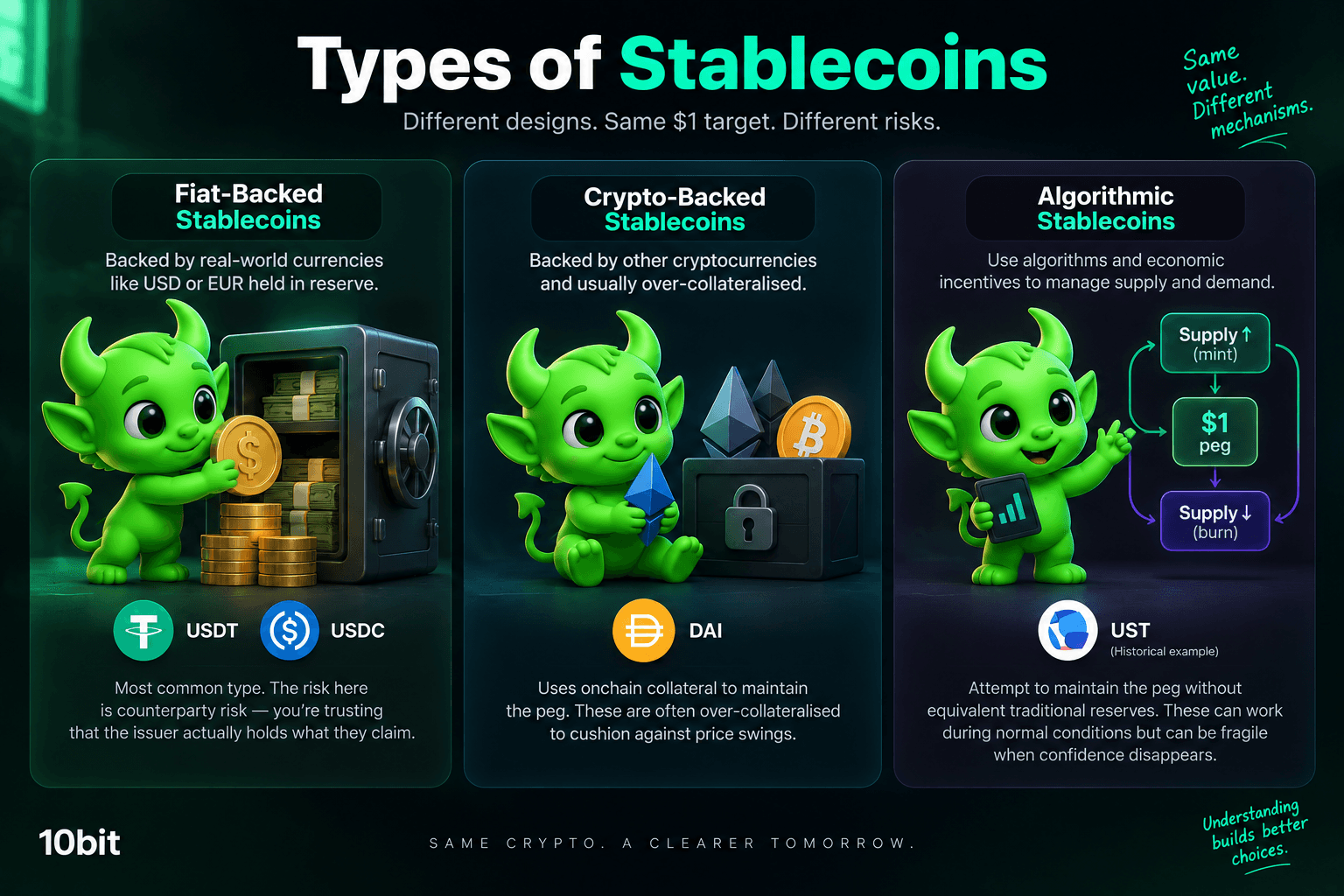
How a stablecoin maintains its peg depends on its design. Fiat-backed stablecoins use reserves such as cash and short-term government securities. Crypto-backed stablecoins use onchain collateral. Algorithmic designs attempt to manage supply and incentives without equivalent traditional reserves.
Each model has different strengths and different failure modes. And all of this ultimately operates using blockchain networks, the same underlying infrastructure that powers much of the crypto ecosystem.
The thing worth understanding early — stablecoins now represent hundreds of billions of dollars in circulating supply. They are not a niche product. They are a major part of how crypto actually functions day to day.
Stablecoins by the Numbers
As of September 2026, the stablecoin market represents roughly $290 billion in value.
USDT: approximately $183 billion
USDC: approximately $74 billion
USDT + USDC: roughly 89% of the stablecoin market
Stablecoins also move trillions of dollars across blockchain networks. But those figures shouldn't be confused with trillions of dollars of everyday payments — trading, settlement, bots and other onchain activity account for a significant share of blockchain transaction volume.
The numbers change. The scale doesn't change the underlying question: what keeps all of that supposedly stable value stable?
Types of Stablecoins
Not all stablecoins are equal. Here's what actually differs.
Fiat-Backed Stablecoins
These are the most common.
Backed by real-world currencies like USD or EUR held in reserve. For every stablecoin in circulation there should ideally be equivalent assets held by the issuer.
USDT and USDC are the two largest dollar-pegged stablecoins by market capitalization. The risk here is counterparty risk — you are trusting that the issuer actually holds what they claim.
Crypto-Backed Stablecoins
These are backed by other cryptocurrencies instead of fiat.
Because crypto is itself volatile these stablecoins are often over-collateralised. To issue $100 worth of stablecoins you might need to lock $150 worth of crypto as collateral. The excess cushions against price swings in the underlying asset.
DAI is one well-known example of a crypto-native stablecoin model, although its backing and system have evolved considerably beyond simply locking volatile cryptocurrency as collateral.
Algorithmic Stablecoins
These don't rely on equivalent traditional reserves. Instead they use algorithms and economic incentives to influence supply and demand in an attempt to maintain the peg.
The risk became painfully clear in 2022 when TerraUSD lost its dollar peg. The collapse of UST and its associated token Luna erased tens of billions of dollars in value and became one of crypto's most infamous failures.
The lesson — an algorithm can maintain a peg during normal conditions. It can struggle catastrophically when confidence disappears and everyone wants out at the same time.
What Happens When a Stablecoin Loses Its Peg?
This is the part most beginner guides skip. We won't. A stablecoin trading at $0.999 isn't necessarily a crisis. Small deviations happen as markets move. The real problem begins when traders stop believing the stablecoin can be redeemed or supported at its intended value.
If confidence disappears holders may rush to sell or redeem simultaneously. Depending on how the stablecoin is backed that pressure tests the reserves, the collateral or the stabilisation mechanism.
A stablecoin is stable only while the system maintaining its peg continues to work — and while people continue to trust that it will.
That trust is the thing worth watching. Not just the price.
Why Stablecoins Matter
Stablecoins are quietly running crypto. Most people haven't noticed. They reduce volatility allowing users to move funds without worrying about sudden price changes.
They function as base currencies on crypto exchanges. Instead of converting crypto into fiat traders often convert into stablecoins to lock in value quickly without leaving the crypto ecosystem.
Stablecoins can make some cross-border transfers faster and cheaper than traditional payment rails, depending on the blockchain, fees and how users convert between stablecoins and local currencies.
Stablecoins now move trillions of dollars across blockchains each year. But not all of that represents people buying goods or sending money — trading, exchange activity and other onchain activity account for a significant share of the volume.
In many ways stablecoins act as the bridge between traditional finance and the crypto world. The part of crypto that actually needs to work reliably every day.
Can Stablecoin Charts Tell You Something About Crypto?
This is where it gets interesting and where most crypto content gets it badly wrong.
Stablecoins are designed to stay close to $1 so their price charts look boring. But sometimes the interesting information isn't the price of the stablecoin itself — it's what traders are doing with stablecoins.
On TradingView traders can watch stablecoin-related charts alongside Bitcoin and the broader crypto market.
Three things worth understanding —
Stablecoin Dominance - the bear
If stablecoins make up a growing share of the total crypto market cap it can indicate that more capital is sitting in dollar-like assets rather than volatile cryptocurrencies. That can happen during periods of uncertainty or risk reduction. (usually you shall spot these with the bear markets)
Stablecoin Supply - the bull or even exit liquidity (top) at times
Growing stablecoin supply can indicate that more dollar-denominated liquidity is entering the crypto ecosystem. That money could eventually move into Bitcoin, Ethereum or other assets — but increased supply alone does not guarantee that it will.
Stablecoin Depegs - Deep bear (bottom) market like in 2022
If a major stablecoin suddenly trades noticeably below $1 the chart can reveal stress or loss of confidence in that particular stablecoin. In severe cases that uncertainty can spill into the broader crypto market.

One important thing — dominance can change because the rest of the crypto market is moving not necessarily because billions of fresh dollars are literally converting into or out of USDT. Correlation is not causation.
Don't treat stablecoin charts as buy or sell signals. They are better viewed as indicators of where liquidity is sitting and how comfortable market participants are with taking risk.
Context. Not a trading call.
How People Actually Use Stablecoins
Beyond trading stablecoins have real-world utility that most people outside crypto haven't considered yet.
Crypto Trading
The most common use. Traders convert volatile assets into stablecoins to lock in value without exiting to fiat. This allows them to stay in the crypto ecosystem and move quickly when they want to buy back in.
Cross-Border Payments
Stablecoins can provide an alternative rail for moving value internationally. Depending on the blockchain, transaction costs and conversion process, they can make some cross-border transfers faster and cheaper than traditional methods.
DeFi
Stablecoins are widely used throughout decentralised finance. Lending, borrowing, liquidity provision — much DeFi activity uses stablecoins because participants often need relatively stable units of value when interacting with financial protocols.
Real-World Use: When Your Currency Is the Problem
Stablecoins become much easier to understand when the alternative isn't a stable bank account — it's a currency rapidly losing purchasing power.
In countries like Argentina and Turkey where local currencies have lost value dramatically people have turned to dollar-backed stablecoins as a way to access dollar-denominated value.
Instead of holding depreciating fiat currency users can convert into stablecoins and store value digitally. This can give them access to dollar-denominated value and allow them to send money internationally without relying entirely on traditional banking infrastructure.
For people in those situations a stablecoin isn't just a crypto product. It can provide access to a relatively stable unit of value their local financial system may not reliably provide.
And if you're holding stablecoins yourself rather than leaving them on an exchange, understanding how crypto wallets actually work becomes just as important as understanding the stablecoin itself.
Risks of Stablecoins
The part nobody talks about honestly enough.
Reserve Risk
Are fiat-backed stablecoins actually backed by what issuers claim?
There have been ongoing debates about reserve transparency and composition. A stablecoin backed by volatile or illiquid assets is riskier than one backed by cash and short-term government securities — even if both display $1 on screen.
Depegging
Even a small deviation from the peg can create concern, while a significant or sustained depeg can trigger panic. If confidence disappears holders may rush to exit simultaneously — exactly the kind of scenario that has tested and broken stablecoins historically.
Smart Contract Risk
Crypto-backed and algorithmic stablecoins can rely heavily on smart contracts. Bugs or exploits in those contracts can have serious consequences.
Regulatory Risk
Governments globally are paying close attention to stablecoins due to concerns around financial stability, payments and monetary policy. Regulation is evolving and how stablecoins operate may change significantly as it develops.
Stablecoins vs CBDCs
Stablecoins and central bank digital currencies can both represent value digitally but they are fundamentally different.
Stablecoins are generally issued by private entities or decentralised protocols and often operate on public blockchain networks. CBDCs are issued directly by central banks and represent sovereign money in digital form.
The distinction is less about digital money versus traditional money and more about who issues it, who controls it and what infrastructure it runs on.
A CBDC is essentially a government saying — we will issue digital currency on our terms on our infrastructure. A stablecoin is a private entity or protocol saying — we will issue something that tracks a currency on a blockchain.
Both are trying to digitise value. The trust model behind each is completely different.
10BIT | Take
Stablecoins are interesting precisely because they're trying to make crypto less interesting. Most cryptocurrencies attract attention because their prices move. Stablecoins are useful when they don't.
But stability isn't magic. Somewhere underneath every stablecoin is a mechanism — reserves, collateral, incentives or some combination — designed to convince the market that one token is still worth what it claims to be worth.
The real question isn't whether a stablecoin says $1 on the screen. It's what keeps that $1 credible when everyone wants their money back at once.
That's the question 2022 answered for algorithmic stablecoins. It's the question regulators are now asking about fiat-backed ones.
And it's the question worth asking before you decide which stablecoin to trust with your money.
Things You May Have Missed
Most people assume stablecoins are interchangeable because they all display $1. They're not. USDT and USDC both target $1. But their reserve compositions, issuers, regulatory standing and smart contract risks are different.
The price on screen is the same. The risk underneath is not.
There's another thing worth noticing.
Despite the number of stablecoins available, the market remains heavily concentrated. As of September 2026, USDT and USDC together represent roughly 89% of total stablecoin market capitalization.
Before using any stablecoin for significant amounts understand what's actually backing it — not just what the price says.
Still Got Questions? FAQs for you
Are stablecoins actually stable?
Stablecoins are designed to maintain a relatively stable value but the peg is not guaranteed. Market stress, reserve concerns, liquidity problems or failures in the underlying mechanism can cause a stablecoin to depeg.
2022 proved this in the most expensive way possible.
What are the most widely used stablecoins?
USDT and USDC are the dominant US dollar stablecoins by market capitalization. They differ in their issuers, reserve structures and regulatory positioning.
Similar prices don't mean identical risks.
Can you lose money with stablecoins?
Yes. A stablecoin can lose its peg, an issuer or protocol can fail, and users can face exchange, wallet, smart contract and regulatory risks.
A stable price target does not make a stablecoin equivalent to cash in a bank account. Understand what you're holding before you hold it.
Related Post

Jul 21, 2026
Crypto prices change like London weather. Learn how supply, demand, whales, leverage, and sentiment drive volatility.

Jul 20, 2026
Learn what cryptocurrency is, how blockchain works, the main types of crypto, and why people use and invest in digital assets.

Aug 3, 2026
What is blockchain? Learn how blockchain works, why it matters, and how it's used beyond cryptocurrency with simple examples anyone can understand.