Smart Contracts Explained: Powerful Code With No Undo Button | 10bit
Smart contracts can move money, power DeFi and execute rules without asking anyone. But code doesn't understand intent. Here's how they work and fail.

Lofi | 10BIT

Smart Contracts in a Nutshell (TL;DR)
A smart contract is a program deployed on a blockchain that executes predefined rules automatically. Despite the name it isn't necessarily smart. And it isn't necessarily a legal contract. When specific conditions are met the code runs. No bank or lawyer needs to manually approve each execution.
That automation is what makes smart contracts powerful. And it's also what makes them dangerous when the code, data or assumptions are wrong.
Key Takeaways
1. A smart contract is code on a blockchain that executes automatically when predefined conditions are met. It doesn't understand what you meant. It executes what you wrote.
2. Smart contracts power DeFi, NFTs, governance and more — but they can also interact with other contracts, creating complex systems where risk travels between applications.
3. Automation makes smart contracts powerful. It doesn't automatically make them safe. Bugs, bad data and irreversibility have cost the industry billions.
A Smart Contract That Executes Itself Sounds Great. Until the Code Is Wrong.
Imagine an agreement where you don't need a lawyer, a bank or a middleman to make sure things happen. The terms are clear. Execution is automatic. Once conditions are met everything happens instantly. That idea is exactly what smart contracts are designed to do.
But here's what most explainers leave out. Smart contracts don't understand what you meant. They execute what you wrote.
And that distinction between intent and instruction is what makes them one of the most powerful and most misunderstood innovations in blockchain technology.
What Are Smart Contracts?
Most people get this wrong from day one. Here's the actual explanation. Despite the name a smart contract isn't necessarily smart. And it isn't necessarily a legal contract. A smart contract is a program deployed on a blockchain that executes predefined logic automatically.
It doesn't require a person to approve each action. It doesn't rely on an institution to enforce the agreement. When the conditions written into the code are met the program runs.
That's it.
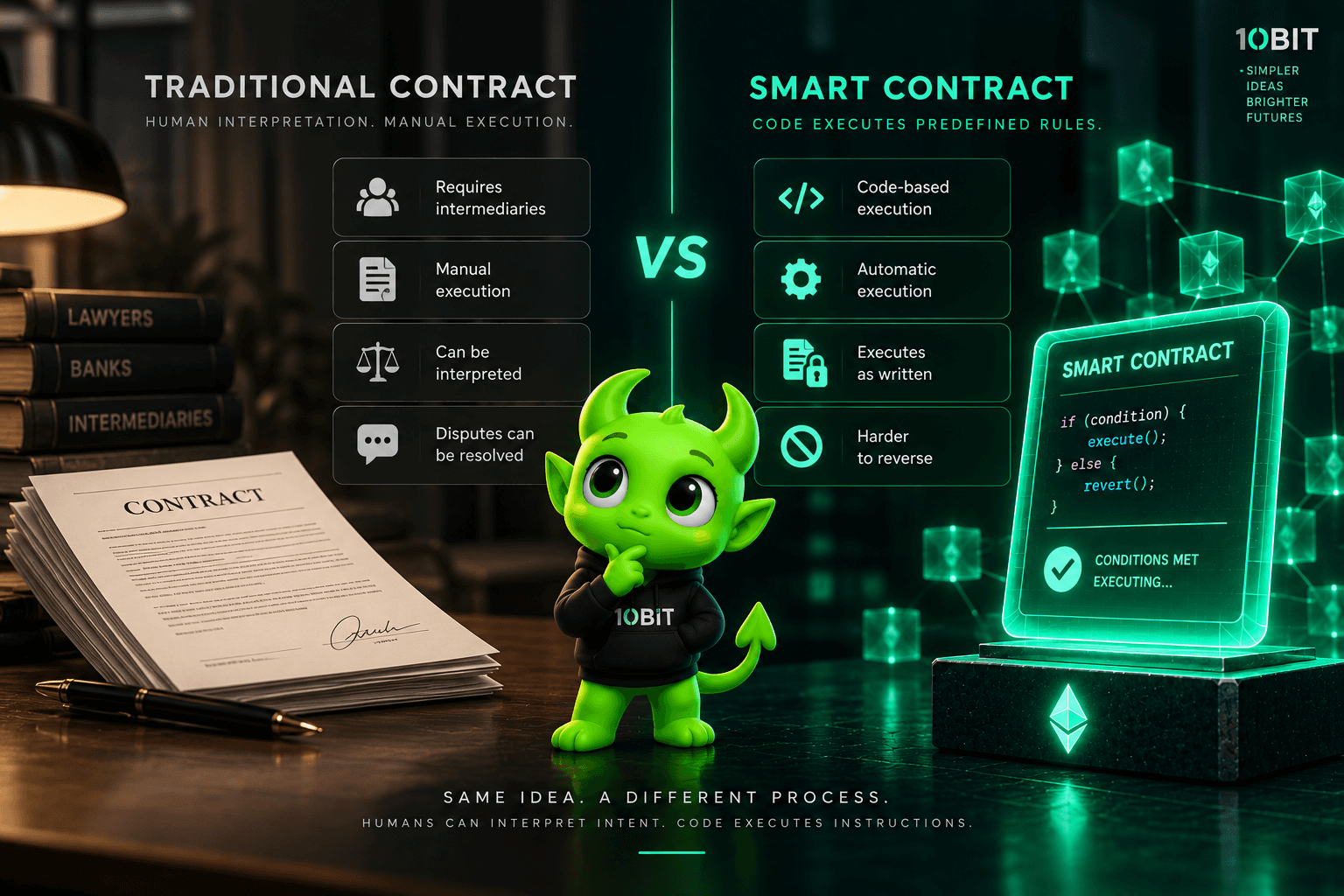
In a traditional agreement two parties define terms. Intermediaries banks, lawyers, platforms ensure those terms are fulfilled. This takes time, involves fees and depends on trust in those institutions.
A smart contract removes that dependency. The agreement is written in code. Once conditions are satisfied the contract executes without requiring approval from anyone.
For a full understanding of the blockchain infrastructure smart contracts run on read our blockchain guide. And if you want to understand how smart contracts power financial systems read our DeFi explainer.
How Do Smart Contracts Actually Work?
This is simpler than it sounds. Stick with it.
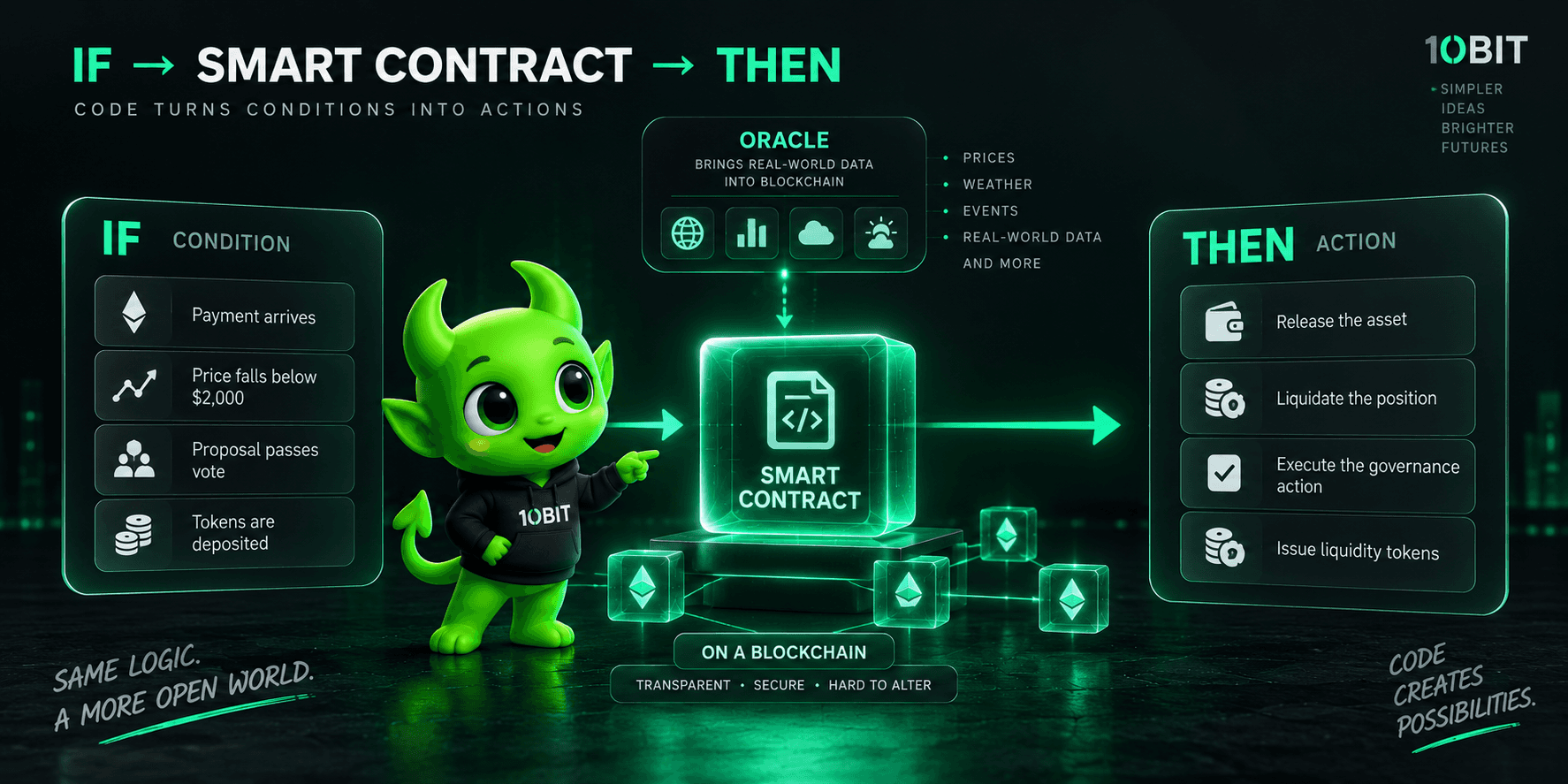
The core logic is just an IF → THEN rule.
IF payment arrives → release the asset
IF collateral falls below threshold → liquidate the position
IF proposal passes vote → execute the governance action
IF tokens are deposited → issue liquidity tokens
The rules can become enormously complicated. But the basic structure remains the same.
Here's how it works in practice.
A smart contract is created with specific conditions written into code. Once deployed it's stored on a blockchain a decentralised network of computers that maintains a shared record of data. That storage makes it extremely difficult to alter after deployment.
When the required conditions are met the contract automatically executes. The network executes and records the contract according to the blockchain's rules.
Ethereum became the best-known early platform for programmable smart contracts and remains a major smart-contract ecosystem today.
Why Put the Code on a Blockchain?
Good question. Couldn't you just run the same code on a regular server? You could. But then you'd have to trust whoever controls the server.
Putting the contract on a blockchain means its activity and execution can be independently verified rather than relying solely on records controlled by one company. Where source code is published and verified, users and researchers can also inspect its logic.
That's the shift blockchain introduces from trusting an institution to trusting verifiable code.
Which brings us to the important nuance. Smart contracts still involve trust. Just different trust. You're trusting the code was written correctly. You're trusting the data feeding it is accurate. You're trusting the blockchain itself continues to function.
DeFi doesn't eliminate trust. It changes what you're trusting. Smart contracts are exactly the same.
What Can Smart Contracts Actually Do?
The applications are vast and still expanding.
Decentralized Finance
This is where smart contracts have had the biggest impact so far. Lending, borrowing, trading, collateral management and liquidations all powered by smart contract logic. DeFi protocols execute these functions automatically without a bank or broker in the middle.
Tokens and Stablecoins
Most tokens on Ethereum and other blockchains are created and governed by smart contracts. The rules around issuance, transfers and permissions are written directly into the contract.
NFTs and Digital Assets
Smart contracts enable provable digital ownership. When an NFT is created, its smart contract can record which blockchain address currently holds the token and define rules around transfers and other interactions.
One important nuance NFT royalties are not universally enforced simply because a smart contract specifies them. Whether royalties are paid depends on whether the marketplace the NFT is sold on honours that contract logic. The code can specify it. Enforcement varies in practice.
DAOs and Governance
Decentralised autonomous organisations use smart contracts to execute decisions made by token holders. Proposals, voting and treasury actions can all be governed by code rather than a board or management team.
Gaming and Digital Economies
Where properly implemented smart contracts allow players to own in-game assets that exist outside the game environment and can be traded or sold independently.
Smart Contracts Can't See the Outside World
This is the part most beginner guides skip. We won't.
Smart contracts can only act on information available to them on the blockchain. But many contracts need information from outside particularly asset prices. Suppose a lending contract says if ETH falls below $2,000 liquidate the collateral.
How does the smart contract know ETH's current dollar price? It can't look it up. A blockchain has no direct connection to outside data. That's where oracles come in.
Oracles are systems that feed external data into blockchain applications. A price oracle might tell a lending protocol the current market price of ETH so the contract can decide whether to trigger a liquidation.
Here's why this matters -
A smart contract can execute its code perfectly and still produce a terrible outcome if the information feeding it is wrong. Code can work exactly as designed. The system can still fail.
Oracle manipulation has been used in real attacks to trick protocols into executing at false prices. Understanding that smart contracts depend on the quality of their inputs not just the quality of their code is essential before using any DeFi application.
Smart Contracts Can Talk to Each Other
One more concept worth understanding composability. Smart contracts can interact with other smart contracts.
That's how complex DeFi applications get built from multiple protocols sometimes described as money legos. One contract can call another which interacts with another. This makes blockchain applications highly flexible and interconnected.
It also means risk travels between systems. If one component in a chain of contracts contains a vulnerability or gets exploited applications depending on it can be affected too. A bug in one protocol can cascade through systems that trusted it.
Understanding composability means understanding that DeFi isn't a collection of isolated applications. It's an interconnected ecosystem where the failure of one piece can affect others.
Smart Contracts vs Traditional Contracts
Traditional contracts allow people and institutions to interpret intent. Smart contracts execute predefined instructions. That difference is both their strength and their weakness.
What Happens When the Code Is Wrong?
Automation removes some human failure points. It creates others.
Bugs and Exploits
Smart contracts are software. Software contains bugs. In traditional systems bugs can often be patched quickly. In blockchain systems the contract may be immutable and any funds locked inside may be permanently at risk. Smart-contract vulnerabilities have contributed to some of crypto's largest exploits. Audited code has been exploited. Unaudited code even more so.
Oracle and Data Risk
As covered above if the data feeding a contract is wrong the contract executes according to wrong information. This has been exploited deliberately to drain protocols.
Irreversibility
Once a smart contract executes it generally cannot be undone. This is very different from traditional systems where transactions can sometimes be reversed or disputed.
Admin Keys and Governance Risk
Some contracts include administrative controls, upgrade mechanisms or governance functions. That means someone a team, a multisig, a DAO may still have significant influence over what the contract can do. Decentralised in code doesn't always mean decentralised in control.
Composability and Dependency Risk
When one contract depends on another a vulnerability in the dependency can affect your application even if your own code is perfect.
Legal Uncertainty
Smart contracts function as programs. Their recognition as legally binding agreements varies by jurisdiction. When disputes arise the legal framework is still catching up. These risks should not be ignored. They're not theoretical they've produced some of the largest losses in crypto history.
10BIT | Take
Smart contracts are powerful because they remove human discretion from parts of an agreement. That's also their weakness.
A lawyer can understand that something clearly wasn't supposed to happen. A bank may freeze a suspicious transaction. A company can correct a mistake.
Code doesn't understand intent. It follows instructions. If the instructions don't represent what the developers meant to happen the blockchain doesn't magically correct them. It executes what was written and records the result permanently.
The interesting question isn't whether code can enforce rules. It clearly can. The interesting question is whether the rules, data and incentives were right in the first place. That's what every smart contract interaction ultimately comes down to.
Things You May Have Missed
Most people assume smart contracts are immutable meaning once deployed they can never change. Many are. But many aren't.
Proxy patterns, upgrade mechanisms and admin keys mean some contracts can be modified after deployment. That gives teams the ability to fix bugs. It also means the contract you interacted with last month might not be exactly the same contract today.
Before using any protocol worth asking can this contract be upgraded? Who controls that upgrade process? What would it take for someone to change what this contract does? The answers matter more than most people check.
Still Got Questions? FAQs for you
Are smart contracts actually legally binding?
It depends on the jurisdiction and the context. Smart contracts are programs that execute on a blockchain. Whether they constitute a legally enforceable agreement depends on local law which is still evolving in most places. The code executes regardless of the legal status. The legal system may not recognise it as a contract.
Can smart contracts be hacked?
The blockchain they run on is extremely difficult to attack directly. The smart contract code itself is a different matter. Bugs in code, manipulation of oracle data and exploits in protocol design have led to billions in losses across the industry. Audited doesn't mean safe. It means checked. Those are different things.
What's the difference between a smart contract and a regular computer program?
A regular program runs on a server controlled by someone. A smart contract runs on a blockchain maintained by a decentralised network. That makes its execution transparent and verifiable — but also means mistakes are much harder to correct and the code interacts with real assets in real time.
Related Post

Sep 9, 2026
What is DeFi and how does it work? Learn how decentralized finance uses smart contracts for trading, lending and borrowing — and understand the risks.

Aug 3, 2026
What is blockchain? Learn how blockchain works, why it matters, and how it's used beyond cryptocurrency with simple examples anyone can understand.

Sep 7, 2026
Bitcoin vs Ethereum: what's actually different? Compare their purpose, supply, technology, use cases and risks — and understand what each was built to do.