DeFi Removed the Bank. It Didn't Remove the Risk.
What is DeFi and how does it work? Learn how decentralized finance uses smart contracts for trading, lending and borrowing — and understand the risks.

Lofi | 10BIT

DeFi in a Nutshell (TL;DR)
DeFi — decentralized finance — is a collection of blockchain-based financial applications that let people trade, lend, borrow and use financial services without relying on a traditional financial intermediary (bank or similar) for every transaction.
Instead smart contracts execute predefined rules while users typically interact directly from crypto wallets. That can make finance more open and programmable. But it also shifts risks and responsibilities that institutions normally handle onto software and users.
Key Takeaways
1. DeFi replaces many financial intermediaries with smart contracts. Instead of a bank or broker processing every action software executes financial rules directly on a blockchain.
2. DeFi isn't just one product. Decentralized exchanges, lending protocols, liquidity pools and yield strategies form an interconnected financial ecosystem.
3. Removing the middleman doesn't remove the risk. Smart contract bugs, bad incentives, volatile collateral and user mistakes can replace some of the risks institutions traditionally manage.
What If Your Bank Was Just Code? That's Basically DeFi.
Imagine applying for a loan. A bank checks your identity, income and credit history before deciding whether you qualify.
Now imagine replacing much of that process with software.You connect a crypto wallet, provide collateral and a smart contract handles the rest.
No loan officer. No branch. No banking hours.
That's the basic idea behind decentralized finance — DeFi. Instead of asking whether we can put banks on a blockchain DeFi asks a more interesting question. How much of finance needs the bank in the first place?
What Is Decentralized Finance?
Most people get this wrong from day one. Here's the actual explanation.
Decentralized finance or DeFi refers to a collection of blockchain-based financial services that operate without traditional intermediaries such as banks, brokers or financial institutions.
In simple terms - decentralized finance is a financial system built on blockchain technology where software replaces many traditional intermediaries.
Instead of relying on banks to manage financial services DeFi protocols use smart contracts to automate them. Users can lend assets, borrow funds, trade cryptocurrencies, earn interest and participate in financial markets directly from their digital wallets. The goal is straightforward to create a more open financial system that anyone can access without needing permission from an institution.
Note - If you want to understand how blockchain technology makes this possible read our full blockchain explainer. And if you want to understand how smart contracts execute financial rules automatically our Bitcoin vs Ethereum guide covers the concept in context.
Why Does DeFi Exist?
Think about how traditional finance actually works. Most financial services rely on intermediaries. Banks hold deposits. Brokerages facilitate trading. Payment processors move money. Lenders approve loans. These institutions play important roles. But they also introduce costs, delays, restrictions and geographic limitations.
Now imagine if software could perform many of those functions automatically and transparently. That idea sits at the heart of DeFi.
Supporters believe financial services should be more open, transparent and accessible. Instead of asking permission from institutions users interact directly with blockchain-based applications.
This vision has transformed decentralized finance from a niche experiment into a global movement.
How Does DeFi Actually Work?
This is simpler than it sounds. Stick with it.
Imagine a vending machine. You insert money. The machine automatically delivers a product. No employee required. No manager approves the transaction. The rules are built into the machine itself.
Smart contracts work in a similar way.
A smart contract is a self-executing program stored on a blockchain. It automatically follows predefined rules. When specific conditions are met the contract performs the required action without human intervention. This automation allows DeFi applications to provide financial services around the clock across borders without a central operator.
Blockchain technology serves as the foundation. Think of it as a public ledger where every action is transparent and verifiable. On public blockchains, transaction activity can be independently verified, while control over individual DeFi protocols varies depending on their design and governance.
And while much of the activity may be publicly visible, transparency doesn't automatically make a protocol easy to understand or safe to use. Ethereum played a major role in popularising DeFi because of its support for smart contracts. Today multiple blockchain networks host DeFi ecosystems.
What Can You Actually Do With DeFi?
The DeFi ecosystem isn't one product. It's an interconnected set of financial applications.
Decentralized Exchanges (DEXs)
Traditional exchanges often require accounts and trust in a central operator. Decentralized exchanges work differently. Users trade directly from their crypto wallets. Smart contracts facilitate transactions without a central intermediary.
Users typically retain control of their assets through their own wallets rather than depositing them with a centralized exchange.
Lending and Borrowing
One of DeFi's most widely used applications. Users deposit assets into protocols and earn interest. Borrowers access funds by providing collateral. Everything is managed through smart contracts with no bank approval and no loan officer involved.
One important thing beginners often ask, if I already have $1,000 of crypto why would I lock it up to borrow $700? Because you might want liquidity without selling your asset. You might want to use borrowed funds in another strategy. Or you might be managing exposure without selling the asset.
Most DeFi loans are overcollateralised, meaning you have to put up more than you borrow. That's fundamentally different from a traditional unsecured personal loan.
Liquidity Pools
Imagine a community-owned vault containing cryptocurrency assets.
Users deposit assets into the vault. Others use those assets for trading, lending or borrowing. Contributors earn rewards in return. That vault is essentially a liquidity pool. Without liquidity pools much of decentralised finance simply would not function.
One thing worth understanding providing liquidity isn't the same as depositing into a savings account. Liquidity providers can face asset price risk, smart contract risk and value-loss effects depending on how prices move relative to each other. Rewards exist because the risk is real.
Yield Strategies
Users can deploy assets across DeFi protocols to earn returns from lending fees, trading activity and other sources.
Although potentially profitable these strategies carry meaningful risks including smart contract vulnerabilities and volatile market conditions.
What Happens When You Remove the Middleman?
This is the part most beginner guides skip. We won't. Banks aren't just annoying middlemen. They also perform identity verification, fraud prevention, credit assessment, custody, dispute resolution, compliance and risk management.
DeFi doesn't make those jobs disappear. It changes who or what handles them.
Instead of trusting a bank to hold assets you may trust your wallet security.
Instead of trusting an institution to execute an agreement you trust smart contract code.
Instead of a bank deciding whether you're creditworthy many DeFi lending systems require crypto collateral.
Removing an intermediary doesn't remove the job the intermediary was doing. It means the system has to solve that job differently.
DeFi doesn't eliminate trust and risk. It rearranges them. That's what makes it much more interesting than simply banking without banks.
DeFi vs Traditional Finance
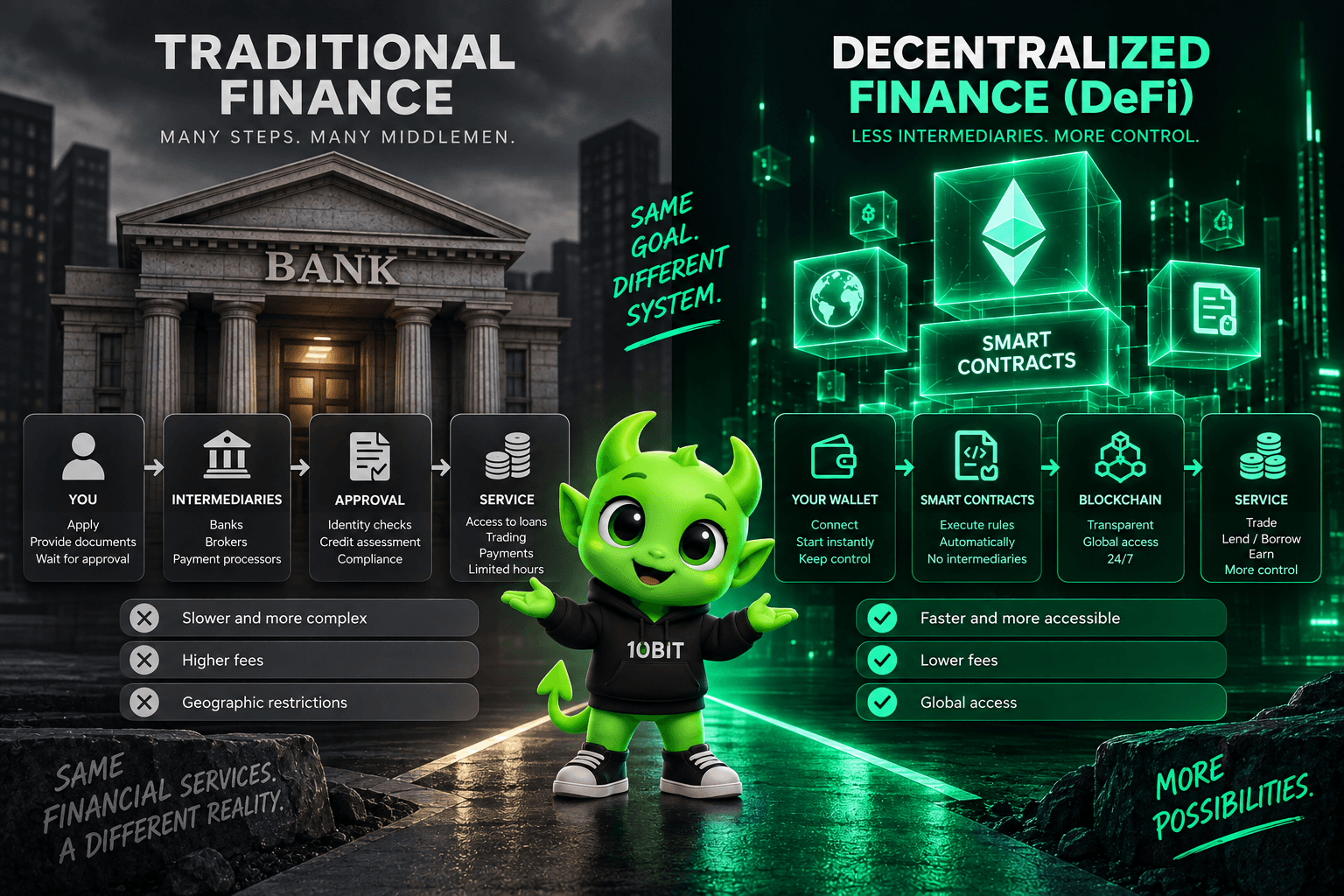
Traditional Finance
Banks approve loans. Brokerages facilitate trading. Payment networks process transactions. These systems provide security and regulatory protection but involve intermediaries, restrictions and significant geographic limitations.
Decentralized Finance
DeFi replaces many of those functions with software. Transactions occur directly between users and protocols. Services operate twenty-four hours a day. Many protocols are designed to be permissionless at the protocol level meaning users can interact without opening a traditional financial account.
In practice access can still vary by interface, jurisdiction and regulation. The trade-off is that users assume greater responsibility for managing their own assets and understanding the risks involved.
What Can Go Wrong?
Replacing institutions with software creates a different set of failure points.
Smart Contract Bugs
Smart contracts are software. Software can contain vulnerabilities. If flaws exist funds may be at risk. Even audited code has been exploited.
Oracle Risk
DeFi protocols often need information about what's happening outside their own contracts particularly asset prices. Because a blockchain can't simply know the outside market price by itself DeFi applications rely on oracle systems that feed external data onchain.
If that information fails or is manipulated the smart contract can execute perfectly according to bad information. Code can work exactly as designed and the system can still fail.
Hacks and Exploits
The DeFi industry has experienced several high-profile security incidents. Attackers target vulnerabilities in protocols, bridges and interfaces.
Liquidation Risk
Because most DeFi loans are overcollateralised if your collateral drops in value below a certain threshold your position can be automatically liquidated. Volatile markets and high leverage amplify this risk significantly.
Volatility
Crypto assets can experience significant price fluctuations. Even well-designed strategies can be affected by market conditions outside anyone's control.
Regulatory Uncertainty
Governments around the world continue developing frameworks for crypto and DeFi. Future regulations could influence adoption, platform operations and user access.
Wallet and User Mistakes
Unlike traditional finance there is often no customer support to call and no transaction reversal. Mistakes made by users can be permanent.
These risks should not be ignored. Understanding them is essential before participating in any DeFi protocol.
10BIT | Take
DeFi is often described as finance without banks. That's true but incomplete.
Banks don't exist simply because nobody thought of replacing them with an app. They perform jobs custody, risk assessment, settlement, compliance, dispute resolution and trust.
DeFi's experiment is whether software, markets and cryptography can perform enough of those jobs differently. Sometimes they can. Sometimes removing the institution simply means the user inherits responsibilities they never realised the institution was handling.
DeFi doesn't remove financial risk. It changes where the risk lives. And that's what makes it much more interesting than banking without banks.
Things You May Have Missed
Decentralized isn't a switch that's either on or off.
A protocol can have decentralized smart contracts while still depending on concentrated governance, centralized front ends, small validator sets, admin keys or external infrastructure.
So asking is this DeFi isn't always enough. A better question is which parts are actually decentralized and which parts still require trust?
That's the question worth asking before you put anything into a protocol.
Still Got Questions? FAQs for you
What is DeFi in simple terms?
DeFi is a group of blockchain-based financial applications that use smart contracts to let people trade, lend, borrow and perform other financial activities without relying on a traditional intermediary for every transaction. Think of it as financial services built on code rather than institutions.
Can you lose money using DeFi?
Yes. DeFi users can lose money through volatile assets, liquidations, smart contract vulnerabilities, malicious protocols, wallet compromises and other risks. Using a decentralized protocol does not make an investment or financial strategy safe. The code can work perfectly and you can still lose funds.
Do you need Ethereum to use DeFi?
No. Ethereum helped popularise DeFi and remains one of the largest ecosystems. But decentralized finance applications operate across multiple blockchain networks including Solana, Avalanche and others. Ethereum is where much of DeFi started. It's not the only place it exists.
Related Post

Aug 3, 2026
What is blockchain? Learn how blockchain works, why it matters, and how it's used beyond cryptocurrency with simple examples anyone can understand.

Sep 7, 2026
Bitcoin vs Ethereum: what's actually different? Compare their purpose, supply, technology, use cases and risks — and understand what each was built to do.

Aug 12, 2026
Your crypto isn't actually inside your wallet. Here's what a crypto wallet really stores, how private keys and recovery phrases work, and how to keep your assets secure.