Staking Pays You More Crypto. But Where Does It Actually Come From?
Is crypto staking really passive income? See where staking rewards come from, how APYs work, and the risks behind earning more crypto.

Lofi | 10BIT

Crypto Staking in a Nutshell (TL;DR)
Staking is how proof-of-stake blockchain networks recruit validators to secure the network and process transactions. Validators put economic value at stake. In return for performing their role correctly they earn protocol rewards.
People who don't run validators themselves can often delegate through validators or services and receive a share of those rewards. That sounds straightforward. The part most articles skip is where those rewards actually come from and what it means for the value of what you're holding.
Key Takeaways
1. Staking rewards aren't free money. They come from new token issuance, transaction fees or both depending on the network. Earning more tokens doesn't automatically mean becoming richer.
2. A high APY doesn't mean a high return. If the token falls 30% while you're earning 6% staking rewards you're still down significantly. The reward is in crypto not in guaranteed value.
3. Staking isn't one thing. Solo validation, delegated staking, exchange staking and liquid staking each come with different tradeoffs around control, risk and liquidity.
Staking Pays You More Crypto. But Where Does It Actually Come From?
Most people in crypto are either trying to time the market, chasing the next coin or constantly checking charts. Staking gets presented as the alternative. Hold your crypto, do nothing, earn more crypto.
That framing isn't wrong. But it's incomplete in ways that matter.
Staking rewards aren't the crypto equivalent of bank interest. The underlying economics are different. The risks are different. And understanding that difference is what separates people who stake thoughtfully from people who chase high APYs without knowing what they're actually getting into.
So before you stake anything here's what actually worth understanding.
For context on how proof-of-stake consensus works read our Bitcoin vs Ethereum guide. And for how smart contracts execute the rules underlying staking protocols read our smart contracts explainer.
What Is Crypto Staking?
Most people get this wrong from day one. Here's the actual explanation.
Crypto staking is the process of committing cryptocurrency to support a proof-of-stake blockchain network's consensus mechanism.
Proof-of-stake networks need validators participants who verify transactions and add them to the blockchain. Validators put economic value at stake as a form of commitment to honest behaviour. In return for performing their role correctly they can earn rewards.
The comparison to bank interest gets used constantly. It's not quite right. When you put money in a savings account a bank lends it out and pays you a portion of what it earns. The underlying asset stays the same.
Staking is different. You're not lending crypto to a bank. You're participating in network security. The rewards come from the network itself not from someone borrowing your assets and paying you back.
That distinction matters more than most beginners realise.
Why Does Proof of Stake Need Staking?
This is simpler than it sounds. Stick with it.
Bitcoin uses proof of work. Miners solve computational puzzles to validate transactions and add blocks to the blockchain. This requires significant energy and hardware.
Proof of stake works differently. Instead of competing with hardware validators commit crypto as collateral. That economic stake creates an incentive to behave honestly — depending on the network, certain validator failures or protocol violations can lead to penalties, including the loss of some staked assets.
Ethereum's transition from proof of work to proof of stake reduced its estimated energy consumption by more than 99%. Instead of miners Ethereum now relies on validators who have staked ETH to secure the network.
The key insight staking creates economic alignment between validators and the network. Validators who perform correctly earn rewards. Validators who behave badly face penalties.
Where Do Staking Rewards Actually Come From?
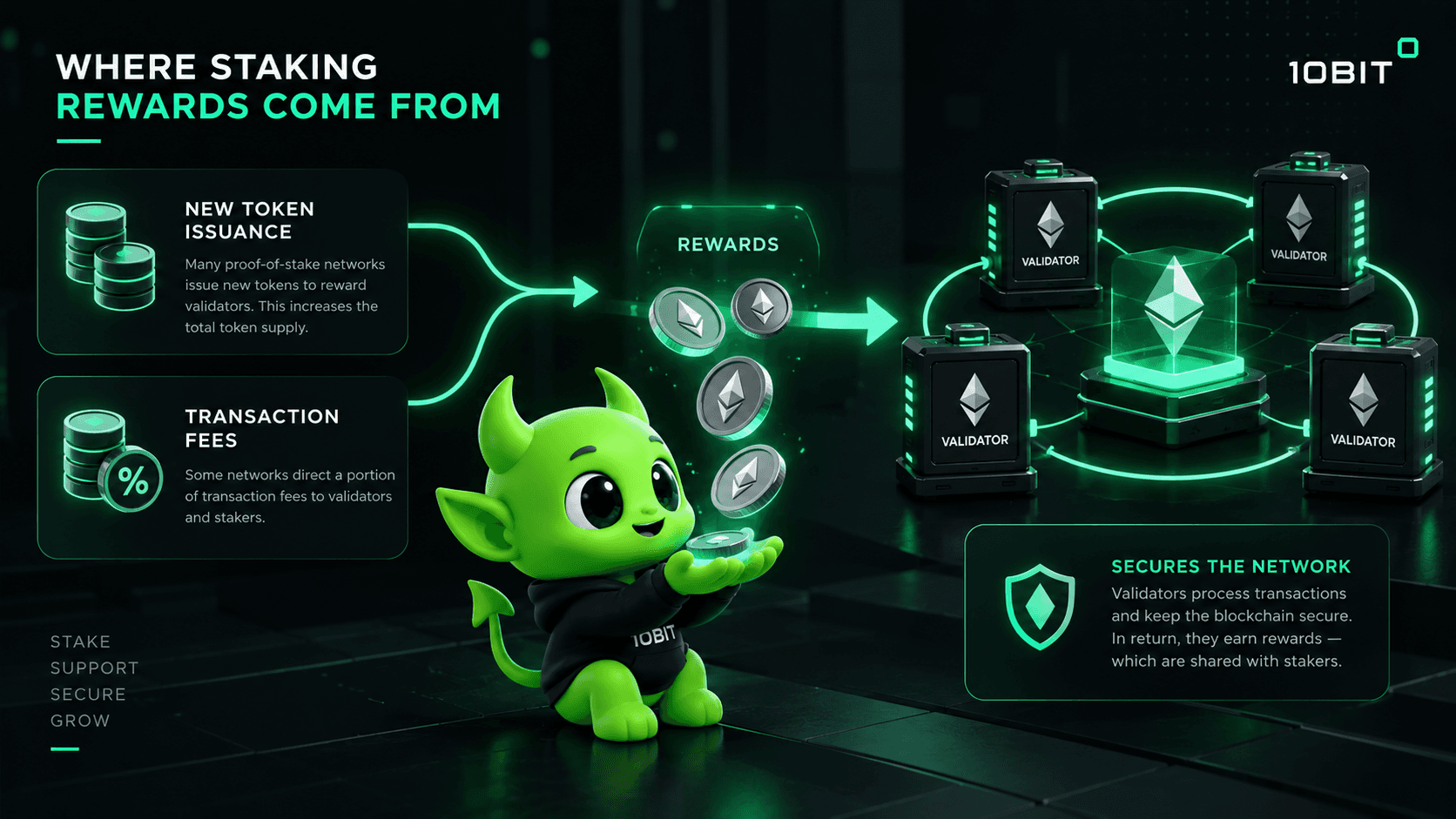
This is the question most staking explainers completely skip. We won't. Staking rewards typically come from two sources depending on the network.
New token issuance. Many proof-of-stake networks issue new tokens to reward validators. This is sometimes called inflation. The network expands its token supply to compensate participants for securing it. Transaction fees. Some networks direct a portion of transaction fees to validators and stakers.
Here's why this matters -
If rewards come primarily from new issuance the overall token supply is expanding. Everyone holding the token is being diluted to some degree. Earning 5% more tokens doesn't automatically mean becoming 5% richer if everyone's share of the total supply is shrinking slightly.
And if the token's price falls meanwhile those 5% extra tokens are worth less than when you started. Earning 6% staking rewards while your asset drops 30% doesn't make staking unprofitable in some abstract sense. It just means you now hold more units of something worth significantly less.
Staking can make holding an asset more productive. It cannot make a bad asset good.
How Can You Stake Crypto?
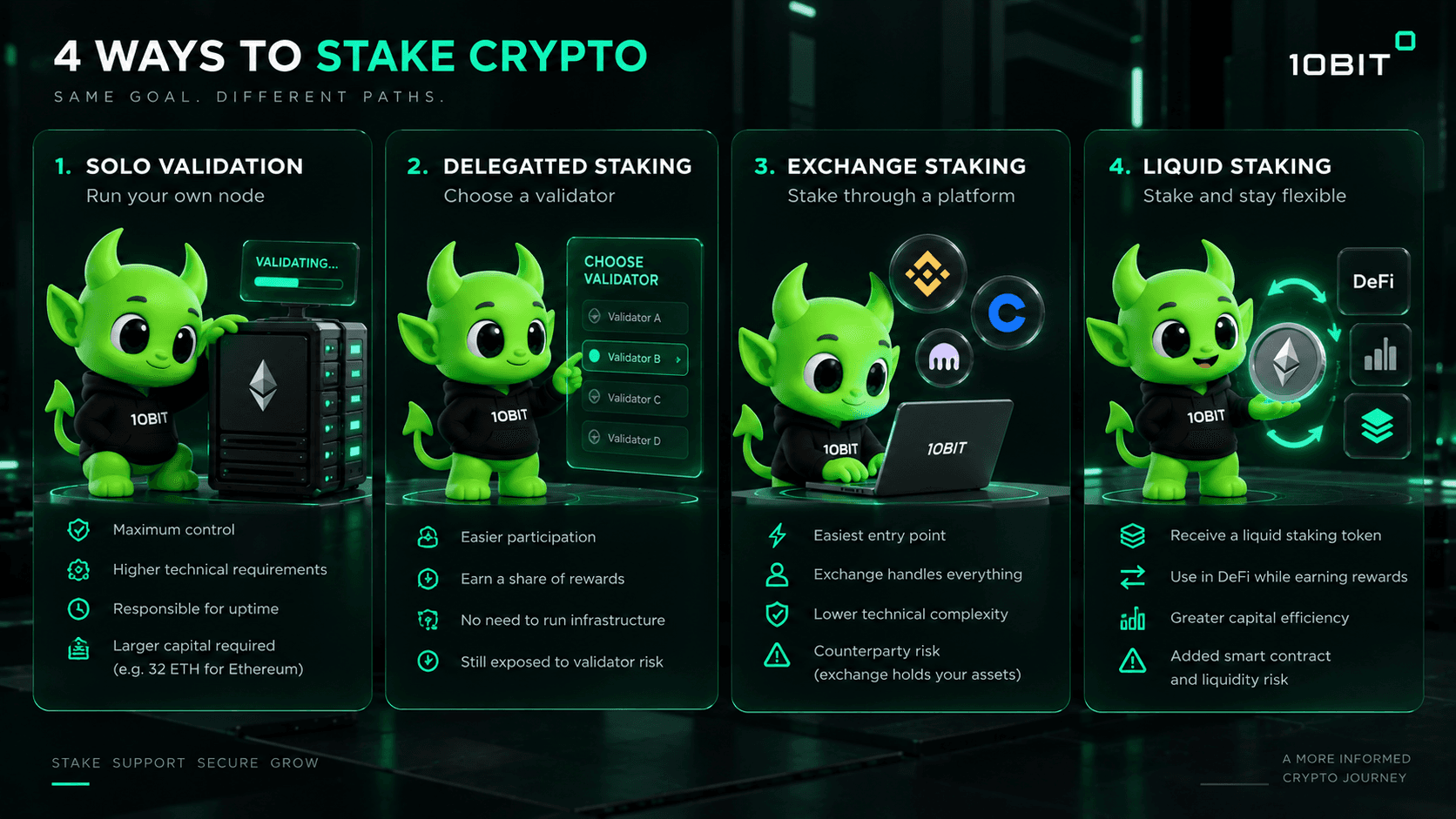
Solo validation gives you the most control but requires more capital and technical responsibility. Delegated staking lets a validator do the technical work, while exchange staking prioritises convenience at the cost of additional counterparty risk.
Liquid staking adds another option: you receive a token representing your staked position that may be usable elsewhere in DeFi. That flexibility can introduce additional smart contract, liquidity and composability risks.
For a full understanding of how smart contracts underlie liquid staking read our smart contracts guide. And for how liquid staking tokens interact with DeFi read our DeFi explainer.
Why a High APY Doesn't Automatically Mean a High Return
This is the part nobody talks about honestly enough. A 15% APY attached to a small network's token sounds attractive. But a few things worth asking before treating it as 15% annual return
Is the APY partly just keeping up with that network's token inflation? If token supply is expanding rapidly, part of that 15% staking yield may simply compensate you for dilution. The headline APY doesn't tell you how much your share of the network or your purchasing power has actually increased.
Has the token maintained value over time? A high yield attached to a depreciating asset is still a loss.
What's the lock-up period? If your funds are locked during a market drop you cannot exit. A 30-day unbonding period during a sharp correction can cost far more than any staking reward covers.
Who controls your assets while staked? Exchange staking means the exchange holds your keys. Liquid staking adds smart contract exposure. Even native delegation involves trusting a validator.
High staking yields are sometimes a genuine reflection of productive network activity. Sometimes they're partly compensation for inflation, illiquidity or additional risk. The number on its own tells you very little.
What Can Go Wrong?
Staking introduces risks that the headline APY doesn't show.
Price Volatility
Staking rewards are earned in crypto not in guaranteed fiat value. If the token drops significantly staking rewards denominated in that token don't offset the loss.
Bonding and Unbonding Periods
Many networks require a waiting period after you unstake before funds are accessible. During that window you cannot sell. If the market moves against you during unbonding you absorb that loss.
Validator Risk and Slashing
Validators who behave incorrectly double-signing, extended downtime or other protocol violations can face penalties. Some networks implement slashing where a portion of the validator's staked funds are destroyed as punishment.
Depending on how you stake this validator risk can affect your rewards or in some cases your principal. Understanding how your chosen network handles validator penalties matters before you delegate.
Platform and Counterparty Risk
Exchange staking means trusting the exchange with your funds. Exchanges have faced insolvency, hacks and withdrawal freezes. The simplest staking route carries its own category of risk.
Smart Contract Risk
Liquid staking and DeFi-integrated staking add smart contract exposure. The protocol code can contain bugs. The liquid staking token can depeg. Applications built on top of it can fail.
Regulatory Uncertainty
Governments are still determining how staking rewards are classified and taxed. Rules can change and may affect staking economics and accessibility.
When Does Staking Actually Make Sense?
Rather than tell you whether to stake here are the questions worth asking yourself first.
Would you hold this token without the staking yield? If the answer is no the APY alone is probably not a good enough reason.
Do you understand where the rewards come from? New issuance versus transaction fees versus protocol incentives carry different implications for the token's long-term economics.
How quickly can you exit if needed? Lock-up periods and unbonding windows affect your ability to respond to market changes.
Who controls your assets while staked? Exchange, validator, smart contract or yourself each involves different trust assumptions.
Can your validator be penalised? And if so how does that affect your position?
Does staking expose you to additional smart contract or platform risk beyond simply holding the token?
Staking isn't automatically good or bad. It's a set of tradeoffs that depend on the asset, the network and how you access it.
10BIT | Take
Staking gets marketed as passive income. The underlying reality is more interesting.
You're not earning yield because crypto wants to reward holders. You're earning rewards because proof-of-stake networks need economic participants to secure them and the rewards are how they recruit and incentivise that participation.
Understanding that changes the question.
Instead of asking how much does staking pay the better questions are why is this network paying me, what is it actually compensating me for, and what risk am I taking in exchange? A 7% staking yield attached to a token falling 50% is not passive income. It's more units of an asset worth less.
And a high staking rate isn't automatically generous. Sometimes it's partly compensation for inflation, illiquidity or additional smart contract risk you may not have noticed you were taking on.
The interesting question isn't how much staking pays. It's why you're being paid and whether the tradeoff makes sense for what you're actually trying to do.
Things You May Have Missed
Staking can change who gets diluted. If a network issues new tokens as staking rewards, holders who don't stake may see their share of the total token supply shrink relative to holders who do. That creates an interesting dynamic. What looks like a reward for staking can also function partly as a penalty for not participating.
So the better comparison isn't always:
staking vs earning nothing.
Sometimes it's:
staking vs being diluted while other holders stake.
Still Got Questions? FAQs for you
Can you lose crypto by staking?
Yes. Beyond price volatility you can lose rewards or in some cases principal through validator slashing, platform failures, smart contract exploits and extended unbonding periods during market drops. Staking is not the same as a guaranteed savings account.
What's the difference between staking and yield farming?
Staking typically involves participating in a blockchain's consensus mechanism directly or through delegation. Yield farming usually involves deploying assets into DeFi protocols to earn returns from liquidity provision, lending or other strategies. Both can generate rewards. Both carry risks. The mechanisms and risk profiles are different.
Do you need a lot of crypto to start staking?
Depends on the method. Ethereum solo validation requires 32 ETH minimum. But delegated staking on networks like Solana or Cardano has no meaningful minimum. Exchange staking platforms often allow staking with very small amounts. The tradeoff is that easier access usually means more counterparty or platform risk.
Related Post

Sep 9, 2026
What is DeFi and how does it work? Learn how decentralized finance uses smart contracts for trading, lending and borrowing — and understand the risks.

Sep 10, 2026
Smart contracts can move money, power DeFi and execute rules without asking anyone. But code doesn't understand intent. Here's how they work and fail.

Sep 7, 2026
Bitcoin vs Ethereum: what's actually different? Compare their purpose, supply, technology, use cases and risks — and understand what each was built to do.