Blockchain Explained with examples : More Than Just Crypto
What is blockchain? Learn how blockchain works, why it matters, and how it's used beyond cryptocurrency with simple examples anyone can understand.
10bits Technologies

Blockchain in a Nutshell
When people hear the word blockchain, they almost immediately think of Bitcoin. That's understandable. Bitcoin introduced blockchain to the world.
But here's the interesting part. If Bitcoin disappeared tomorrow, blockchain as a technology would still exist. Banks are experimenting with it. Supply chains are using it. Governments are testing it. Companies are building entirely new products on top of it.
Crypto was the first real-world application.
Blockchain is the invention that made it possible.Blockchain is a shared digital ledger that records information across thousands of computers instead of storing it in one central place. Every new transaction is verified by the network, grouped into a block, and permanently added to the chain.
Because no single person controls it and every participant shares the same record, blockchain makes data far more transparent, secure and difficult to manipulate.
Key takeaways
Blockchain isn't cryptocurrency. Cryptocurrency is simply one of the first major applications built on blockchain technology.
Instead of trusting one company or authority, blockchain relies on a network of computers that collectively verify and store data.
Beyond finance, blockchain is already being used in supply chains, digital identity, smart contracts and enterprise systems because it creates a permanent, tamper-resistant record of information.
What Is Blockchain? A Simple Guide with Real Examples
If you’ve heard of bitcoin or cryptocurrency, you’ve already come across the word blockchain. But here’s the truth most people miss: crypto is just one use of blockchain. The real innovation is the technology itself.
So, what is blockchain and why is everyone talking about it?
In simple terms, blockchain is changing how information is stored, shared, and trusted on the internet. It removes the need for middlemen, reduces fraud, and allows people to interact directly in a secure way. That’s why industries from finance to supply chains are exploring it.
Let’s break it down in a way that actually makes sense.
What Is Blockchain
At its core, blockchain is a digital record, also known as a ledger, that stores data in a secure and transparent way.
Instead of being controlled by a single company or authority, it is decentralized. This means no one person or organization owns it. The data is shared across a network of computers.
Think of it like a shared Google Sheet that thousands of people can see and verify, but no one can secretly edit.
This is what makes blockchain different from traditional systems.
How Blockchain Works
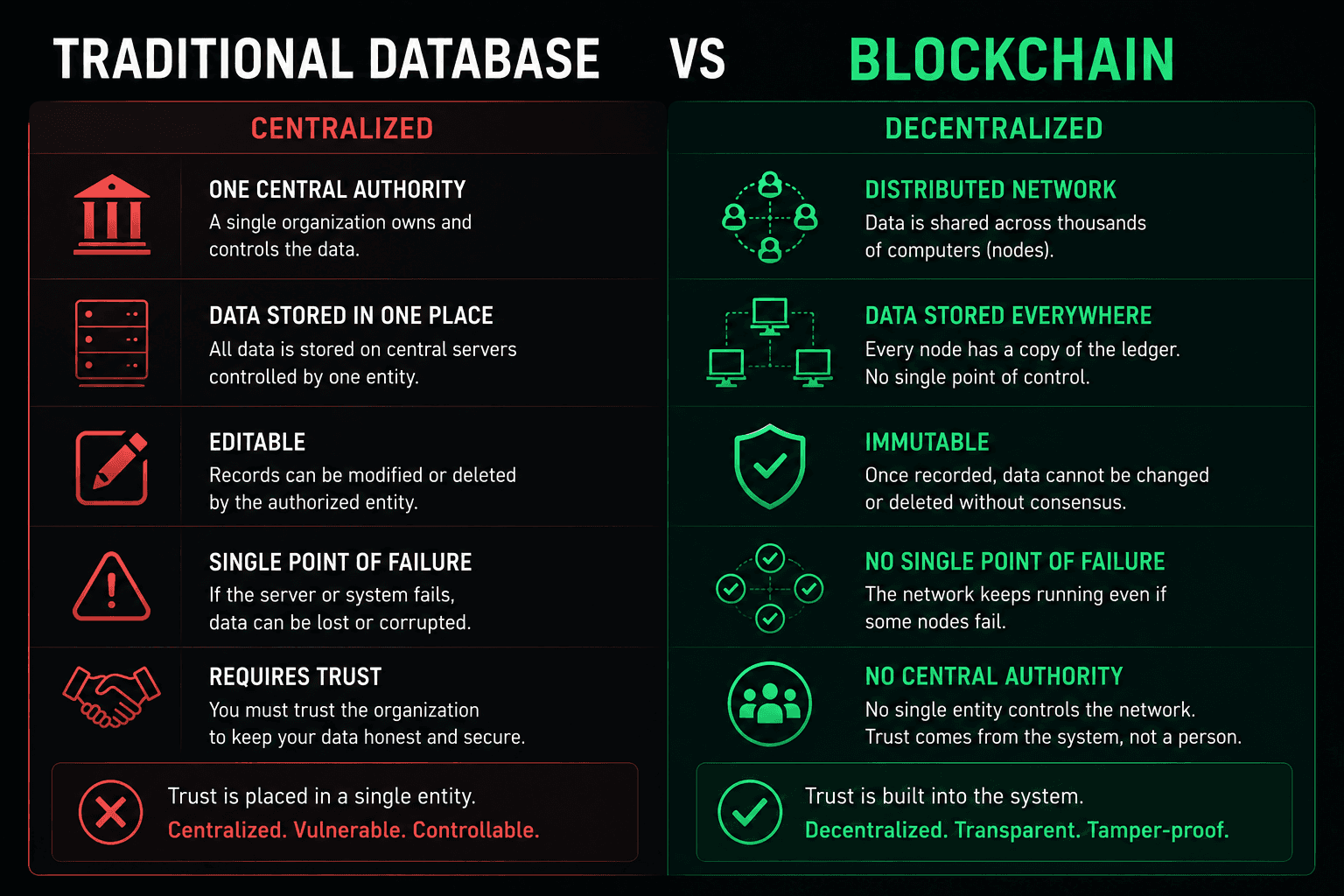
To understand what blockchain is, you need to understand how it records transactions.
Imagine you're sending Bitcoin to a friend.
Here's what happens behind the scenes.
You create a transaction by sending Bitcoin from your wallet to your friend's wallet.
The transaction is broadcast to the blockchain network, where thousands of computers receive it.
These computers verify the transaction by checking that you actually own the Bitcoin and haven't already spent it.
Once verified, your transaction joins hundreds or even thousands of other verified transactions. Together, they form something called a block.
Every new block is linked to the block before it, creating one continuous chain of records. That's literally where the name blockchain comes from.
Once the block is added, every computer on the network updates its own copy, meaning everyone shares the exact same version of the ledger.
Think of blockchain like a notebook. Every page is a block filled with transactions. Once a page is full, you don't erase it or rewrite it you simply add the next page. Over time, those pages form one complete, permanent history of every transaction ever made.
Here is what makes it powerful:
The system does not rely on a central authority
Every participant in the network helps verify transactions
The data is constantly updated and shared
For example, the Bitcoin blockchain processes thousands of transactions every day. As of recent data, it handles over 300,000 transactions daily, all without a central bank.
Ever wonder why was blockchain invented?
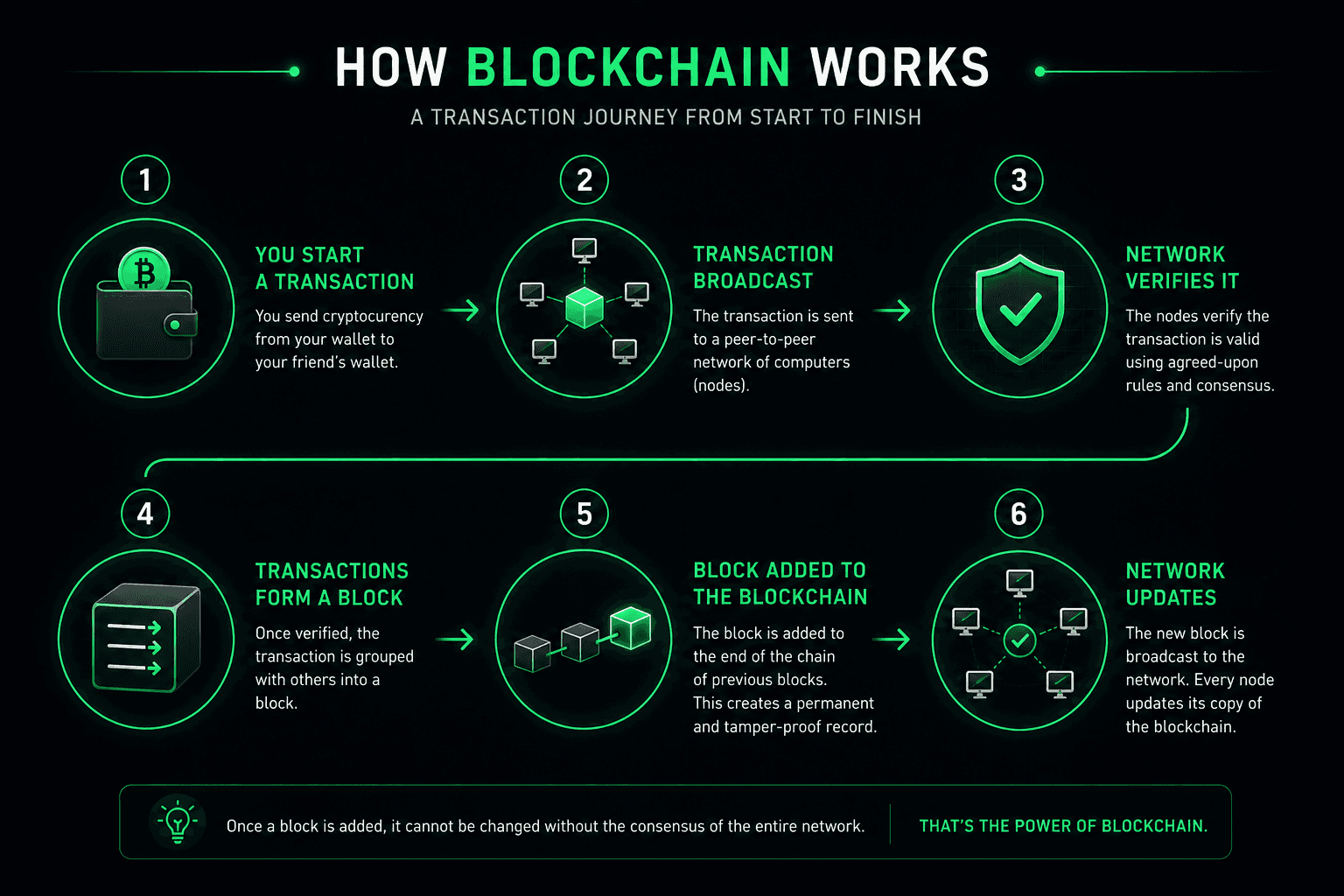
Before blockchain, digital information always relied on someone owning the database. Whether it was a bank, government or company, you had to trust one central authority to keep records honestly. Blockchain was created to solve that trust problem by allowing everyone to verify the same record together.
Key Features of Blockchain
Blockchain stands out because of a few core features that make it different from traditional systems.
Decentralization
There is no central control. Instead of one server holding all the data, the information is spread across many computers. This reduces the risk of a single point of failure.
Transparency
All transactions are recorded on a public ledger. Anyone can view them, which builds trust. For example, you can track any Bitcoin transaction using public blockchain explorers.
Security
Blockchain uses advanced cryptography to protect data. Once a transaction is verified, it is extremely difficult to alter. This makes it ideal for handling valuable digital assets.
Immutability
Immutability means that once data is recorded, it cannot be changed easily. For instance, if someone tries to alter a past transaction, they would need to change every block after it across thousands of computers. This is practically impossible.
Types of Blockchain
Not all blockchains are the same. There are different types of blockchain systems depending on how they are used.
Public Blockchain
This is open to everyone.
Anyone can join, view transactions, and participate. Bitcoin and Ethereum are examples of public blockchains. These are fully decentralized and transparent.
Private Blockchain
This is controlled by a single organization.
Access is restricted, and only selected participants can use the network. Companies often use private blockchains for internal processes.
Hybrid or Consortium Blockchain
This is a mix of both.
It is controlled by a group of organizations rather than one. It offers more control than public blockchains but more transparency than private ones.
This type is often used in industries like banking or supply chain management.
Real-World Use Cases of Blockchain
Blockchain is not just about cryptocurrency. It is already being used in real-world applications.
Digital Currency
The most well-known use is digital currency like Bitcoin.
Bitcoin has a market value that has crossed hundreds of billions of dollars, showing how widely blockchain is being adopted. It allows people to send money globally without banks.
Smart Contracts
Smart contracts are programs that run on blockchain and execute automatically when conditions are met.
For example, imagine renting a house. A smart contract could automatically release payment to the owner once you receive access to the property.
This removes the need for intermediaries. Ethereum is one of the most popular platforms for smart contracts, handling millions of such transactions.
Supply Chain Tracking
Blockchain is also used to track products.
For example, companies like Walmart use blockchain to trace food items. What used to take 7 days to track can now be done in seconds using blockchain. This improves transparency and reduces fraud. The HOW will be shared in my other upcoming blog.
Risks and Limitations
While blockchain is powerful, it is not perfect.
One challenge is complexity. The technology can be difficult to understand, especially for beginners.
Another issue is scalability. Some blockchains struggle to handle large numbers of transactions quickly. For example, Bitcoin can process around 7 transactions per second, compared to thousands processed by traditional payment systems like Visa.
Adoption is also a challenge. Many industries are still exploring how to integrate blockchain into their systems and consider blockchain as crypto.
10BIT take
So, what is blockchain?
Blockchain isn't valuable because it's complicated. It's valuable because it changes where trust comes from.
For decades, we've trusted banks to move money, governments to maintain records and companies to store our data. Blockchain asks a different question: What if trust didn't have to come from a single institution at all?
Whether blockchain becomes as revolutionary as many believe is still unfolding. Some ideas will fail, others will quietly become part of everyday life. But the shift it introduced is already significant. It changed the conversation from "Who owns the database?" to "Does anyone need to own it?"
That's a much bigger idea than cryptocurrency.
Still have questions? FAQs for you
Can blockchain exist without cryptocurrency?
Yes. Blockchain is simply a way of storing and verifying data. While cryptocurrencies use blockchain, businesses and governments are increasingly exploring it for supply chains, identity verification, healthcare records and many other applications.
Is blockchain the same as Bitcoin?
No. Bitcoin is a cryptocurrency built on blockchain technology. Blockchain is the underlying infrastructure that allows Bitcoin and many other applications to function.
Can blockchain be hacked?
Hacking a public blockchain like Bitcoin is extremely difficult because thousands of computers maintain the same ledger. However, exchanges, wallets and applications built on top of blockchain can still be compromised if they have weak security.