Why Crypto Keeps Crashing and Recovering: The Market Cycle Nobody Explains Properly
Learn how crypto market cycles work, from accumulation to bull and bear markets. Understand market phases, investor psychology, and price movements.
10bits Technologies

Crypto market cycles in a nutshell
Crypto doesn't just go up or down randomly. It moves in cycles. Accumulation, bull run, distribution, bear market rinse and repeat. Every cycle looks different on the surface but the psychology driving it is always the same. Greed pushes prices up. Fear pushes them down. Understanding this doesn't let you predict the market but it stops you from making the dumbest mistakes most beginners make.
Key Takeaways
Crypto moves in four phases —accumulation, bull market,distribution, bear market. Learning to recognise them changes how you invest
Fear and greed drive crypto more than any fundamental. The market is basically mass
psychology playing out in real time.You can't time the market perfectly. But understanding cycles stops you from buying
at the top out of FOMO and selling at the bottom out of panic.You can't time the market perfectly. But understanding cycles stops you from buying at the top out of FOMO and selling at the bottom out of panic considering emotions are kept aside.
Market Cycles and Phases: How Crypto Markets Really Move
If you’ve spent even a little time watching crypto markets, you’ve probably noticed something strange. Prices don’t just go up or down randomly. They move in waves. There are periods where everything is rising, optimism is everywhere, and new investors rush in. Then suddenly, the mood shifts. Prices fall, fear takes over, and people exit the market.
This repeating pattern is what we call market cycles and phases. Understanding these cycles is one of the most important skills in crypto. It helps you make sense of price movement, avoid emotional decisions, and understand why markets behave the way they do.
What Are Market Cycles?
At a basic level, market cycles are repeating patterns of growth and decline. They are not perfectly predictable, but they follow similar structures over time. In crypto markets, these cycles are often more intense than in traditional finance. Prices can rise sharply over months and then fall just as quickly. These cycles are driven by market participants, meaning the people buying and selling. Their behavior, expectations, and emotions shape the direction of the market.
If you look at Bitcoin’s history, you will notice this clearly. There have been multiple cycles where prices surged dramatically, followed by sharp corrections. For example:
In 2017, Bitcoin rose from around $1,000 to nearly $20,000
In 2018, it dropped by more than 80 percent
In 2021, it reached over $60,000 before falling again
These are not random movements. They are part of a cycle.
The Phases of a Market Cycle
Every cycle typically moves through different phases. Understanding these phases helps you read price action more clearly.
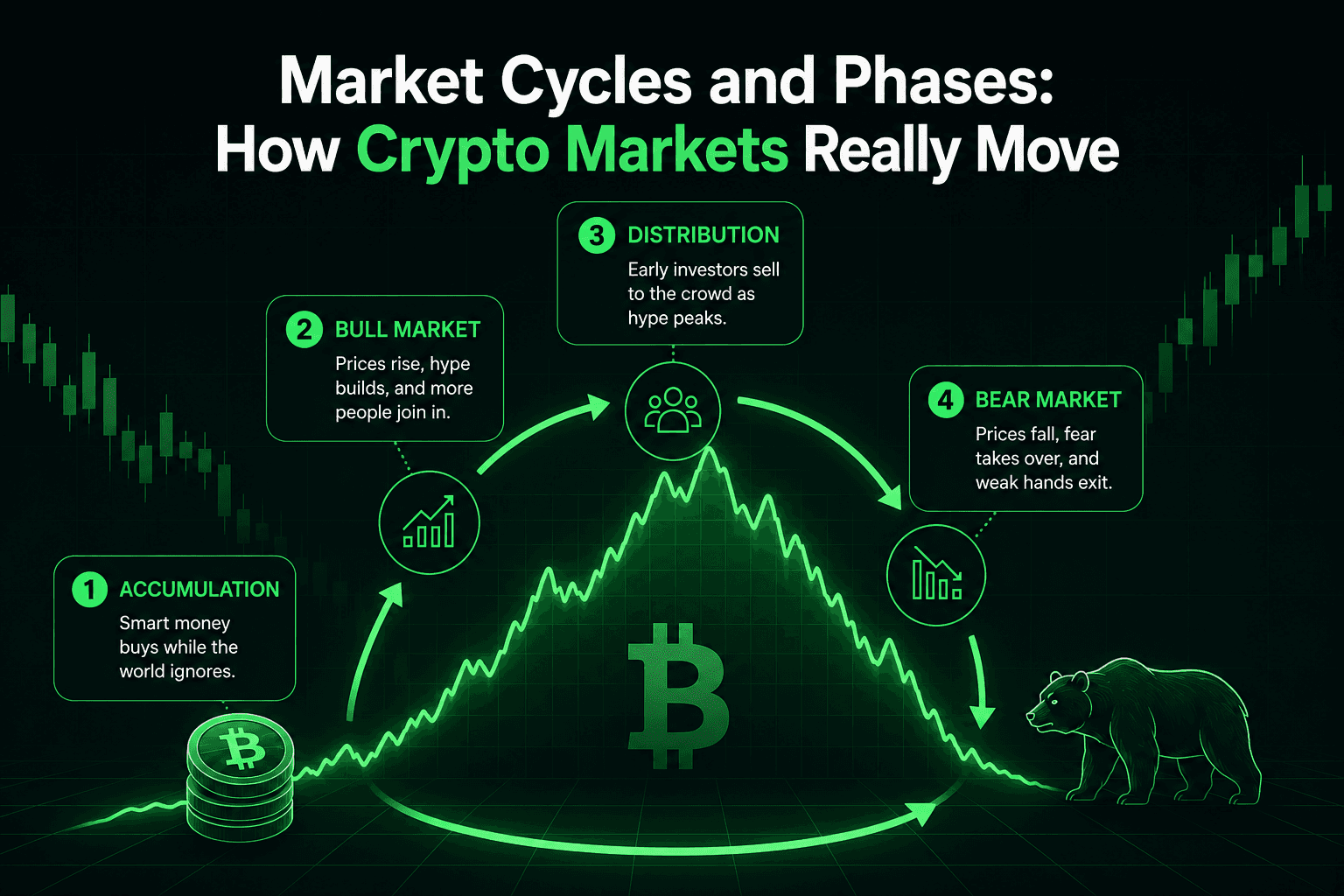
Accumulation Phase
This is where a cycle begins. Prices are low, and most people are not paying attention. News coverage is minimal, and interest is low. However, experienced investors quietly start buying. Trading volume is usually lower during this phase, but steady.
This phase often comes after a long bear market, when the market sentiment is still negative.
Uptrend or Bull Phase
As buying continues, prices begin to rise. This marks the start of a bull market. At first, the growth was gradual. Then momentum builds. More people notice the rising prices. Media coverage increases. New investors enter the market. Trading volume starts to rise significantly. This is where the strongest price movement happens.
For example, during the 2020 to 2021 cycle, Bitcoin rose from around $10,000 to over $60,000 within a year. This rapid increase attracted millions of new participants.
Distribution Phase
At this stage, prices are high, and the market feels extremely optimistic. This is where experienced investors start selling their holdings to newer participants who are entering late. The market may still rise, but signs of slowing growth begin to appear. Price action becomes less consistent.
This phase is often driven by hype, and many investors believe prices will keep rising indefinitely.
Downtrend or Bear Phase
Eventually, the market turns. Prices begin to fall, marking the start of a bear market. At first, people believed it was just a temporary dip. But as prices continue to decline, confidence drops. Selling increases, and trading volume spikes during sharp drops. Fear takes over, and many investors exit at a loss.
This phase can last months or even years, depending on broader conditions like interest rates and global economic factors.
Bull Market vs Bear Market
To understand market cycles and phases, you need to clearly understand the difference between a bull market and a bear market.
A bull market is defined by rising prices, optimism, and strong demand. Investors feel confident, and there is a belief that prices will continue to increase. In contrast, a bear market is defined by falling prices, fear, and uncertainty. Investors become cautious, and many prefer to stay out of the market.
These two phases influence behavior very differently.
During a bull market, people are more willing to take risks. During a bear market, they focus on protecting their capital.
What Causes Hype in Crypto Markets
One of the defining features of crypto markets is how quickly hype builds. This usually starts with a strong narrative. It could be a new technology, a major upgrade, or a new category like NFTs or DeFi. Media coverage plays a big role. As prices rise, news outlets begin reporting on the growth. Social media amplifies the excitement.
Influencers and online communities add to the momentum. This brings in new investors who may not fully understand the market but are attracted by the potential profits.
For example, during the 2021 bull market:
Google searches for “Bitcoin” reached all-time highs
Crypto apps saw millions of new downloads
Trading volume across exchanges surged significantly
This influx of new participants pushes prices even higher, creating a cycle of hype and demand.
The Role of Fear and Greed
Markets are not just driven by logic. They are heavily influenced by emotions. The fear and greed index is often used to measure market sentiment. When the market is driven by greed, prices rise quickly. People rush to buy because they do not want to miss out. This is often when prices reach their peak.
When the market is driven by fear, prices fall. People sell to avoid further losses, sometimes at the worst possible time.
This emotional cycle repeats in every market cycle.
For example:
During peak bull markets, the fear and greed index often shows extreme greed
During deep bear markets, it shows extreme fear
Understanding this helps you avoid reacting emotionally to price movement.
Why Beginners Lose Money
Many new investors struggle in crypto markets, and the reason is usually not the market itself. It is timing and behavior.
A common mistake is entering during the hype phase. When prices are already high and everyone is talking about crypto, it often feels like the right time to invest. In reality, this is usually close to the top of the cycle.
Another issue is lack of strategy. Without understanding market cycles and phases, investors make decisions based on short-term price movement rather than long-term trends. Emotional decision-making also plays a big role. Buying out of greed and selling out of fear leads to losses.
For example, many investors who bought Bitcoin near $60,000 in 2021 ended up selling during the crash below $30,000, locking in losses just to see it go to $100,000.
The Bigger Picture: What Drives These Cycles
While psychology is a major factor, external conditions also influence cycles. Interest rates, for example, affect liquidity in the market. When interest rates are low, more money flows into risk assets like crypto. When rates rise, liquidity tightens, and markets often slow down.
Institutional participation also plays a role. As more large investors enter crypto markets, cycles may become more structured over time.
Conclusion: Understanding Market Cycles
Market cycles and phases are a natural part of crypto markets. They are driven by a combination of human behavior, economic conditions, and technological developments.
Prices will rise and fall. That is normal. What matters is how you respond to these movements. By understanding market sentiment, tracking price action, and recognizing where the market might be in its cycle, you can make better decisions. Instead of reacting to hype or panic, you begin to see the bigger picture.
And in crypto, that perspective makes all the difference.
Still Have Questions? FAQ for you
Can a bull market turn into a bear market suddenly?
Yes. And it happens faster than most people expect. One big regulatory announcement, one macro event, one whale exit — and the mood shifts overnight. No trend in crypto lasts forever. That's not pessimism, that's just how the market works.
Do all cryptos follow the same market cycle?
Not exactly. Bitcoin usually sets the overall direction but individual coins can move very differently. Some altcoins pump hard during bull runs and crash harder during bear markets. Others move on their own project fundamentals entirely.
How do beginners avoid getting wrecked during market cycles?
Stop reacting to price. Seriously. Most beginner mistakes happen because of FOMO at the top and panic at the bottom. Understand which phase the market is in, have a strategy before you invest, and don't make decisions based on what crypto Twitter is saying that day.
Related Post
Jul 21, 2026
Crypto prices change like London weather. Learn how supply, demand, whales, leverage, and sentiment drive volatility.
Jul 21, 2026
Discover why millions invest (or regret investing) in cryptocurrency. Learn about Bitcoin, blockchain, decentralization, high returns, risks, and whether crypto is right for you.

Jul 20, 2026
New to crypto? Before the bear market potentially ends in this october learn what cryptocurrency is, how blockchain works, the different types of cryptocurrencies, and why millions of people invest in digital assets.