Why Iran Is Demanding Crypto Payments for Oil Ships (Strait of Hormuz Explained)
Why is Iran exploring crypto payments for oil shipments? Learn how the Strait of Hormuz, sanctions and blockchain could reshape global trade.
10bits Technologies

Why Iran Is Demanding Crypto Payments for Oil Ships (Strait of Hormuz Explained)
When most people think about cryptocurrency, they think about investing.
When governments think about cryptocurrency, they think about something very different.
Imagine controlling one of the world's most important trade routes while being cut off from the global banking system. How do you collect billions of dollars in payments if traditional financial networks won't let you?
That's the question at the heart of the Strait of Hormuz. And it's one of the clearest examples of why cryptocurrency is no longer just an investment; it is becoming a geopolitical tool.
To understand why this matters, you need to look at both the geography and the economics behind it.
Key takeaways
1. The Strait of Hormuz is one of the world's most important oil routes, with nearly 20% of global oil passing through it. Even small disruptions can impact energy prices worldwide.
2. Countries facing financial sanctions are increasingly exploring cryptocurrency and stablecoins as alternative payment systems for cross-border trade, reducing reliance on traditional banking networks.
3. This isn't just a story about Iran. It's a glimpse into how blockchain technology could gradually become part of global financial infrastructure beyond investing and trading.
What Is the Strait of Hormuz and Why It Matters
The Strait of Hormuz is a narrow waterway between Iran and Oman, but its global importance is enormous.
Around 17 to 20 million barrels of oil per day pass through it
This represents nearly 20 percent of global oil consumption
According to the U.S. Energy Information Administration, it is the world’s most important oil transit chokepoint
For countries like India and China, a significant portion of imported energy depends on this single route. Even a small disruption can push oil prices up globally.
For example, during tensions in 2019 when tankers were attacked in the region, crude oil prices jumped by nearly 4 percent in a single day. That shows how sensitive markets are to events in this area.
What Happened During the Conflict
With rising Iran war tensions, the situation in the strait has become more unpredictable.
In past escalations:
Several oil tankers were seized or temporarily detained
Shipping insurance premiums increased by 30 to 50 percent
Traffic slowed as companies avoided the route
In 2023 and 2024, similar patterns were observed where vessel tracking data showed reduced movement during peak tension periods.
When ships are delayed or rerouted, it disrupts oil shipments globally. This creates supply uncertainty, which directly impacts pricing and trade flows.
Iran’s Control Over the Strait
Iran’s location gives it direct influence over the Strait of Hormuz. While it does not legally “own” the strait, its military presence allows it to control movement during conflict situations. This has led to discussions around:
Ships requiring clearance or approval to pass
A possible shipping toll system
Selective access depending on diplomatic relations
In practical terms, this means Iran can influence who gets access and under what conditions. This control becomes even more powerful when combined with financial restrictions caused by sanctions.
Why Iran Is Asking for Crypto Payments
Iran has been cut off from much of the global financial system due to sanctions. It cannot easily process cross border payments through traditional banking channels or use the US dollar efficiently.
This is where iran crypto payments become relevant.
Cryptocurrency allows transactions to happen outside traditional systems. It removes the need for banks and reduces the ability of external authorities to block payments. There are already real-world examples of this approach.
Iran has previously used crypto for import payments, including goods worth millions of dollars
In 2022, reports confirmed Iran executed its first official import order using cryptocurrency
Countries like Venezuela have also explored crypto to bypass sanctions
These examples show that crypto payments are not theoretical. They are already being used in restricted economies.
How the Crypto Payment System Could Work
If implemented, the system would likely function as a structured toll mechanism tied to oil shipments.
A realistic model would look like this:
A ship carrying oil enters the Strait of Hormuz and is required to pay a fee based on cargo volume.
For example:
Estimated toll: $1 per barrel
Now consider the numbers:
17 million barrels per day × $1 = $17 million daily revenue
Monthly = over $500 million
Yearly = over $6 billion
Even if only 30 to 40 percent of ships are charged, Iran could still generate billions annually.
How the transaction would happen
The process would likely follow a simple flow.
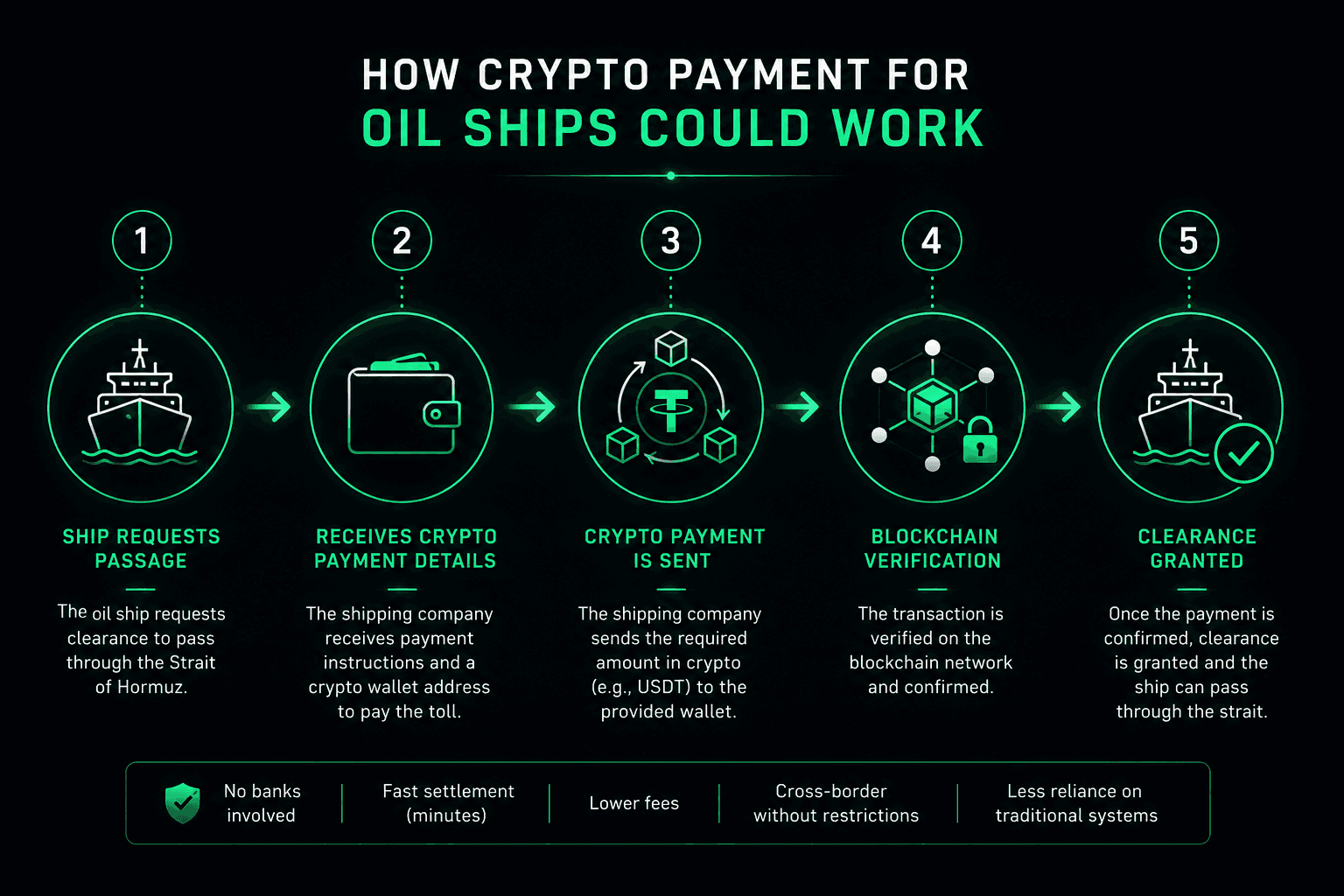
First, the shipping company requests passage. Then it receives payment instructions linked to a crypto wallet. The payment is made using crypto, verified on the blockchain, and clearance is granted.
Which cryptocurrencies could be used vs a stablecoin
The choice of cryptocurrency would depend on stability, speed, and acceptance.
Bitcoin payments are the most obvious option due to global recognition. However, Bitcoin’s price fluctuations make it less practical for fixed toll systems. Stablecoins such as USDT or USDC are more likely candidates.
They are pegged to fiat currency, which reduces volatility
They are widely used for cross border payments
They offer faster and cheaper transactions
For example, USDT on the Tron network processes transactions in seconds with minimal fees. This makes it ideal for high-volume, repeated payments like shipping tolls.
Ethereum-based stablecoins could also be used, though they may involve higher fees.
The Dark Side of Crypto
If this sounds incredibly efficient, that's because it is.
But this is also where crypto gets dangerous.
If two parties control their own wallets, they don't need a bank, payment processor or even an exchange to move money. They can transfer millions of dollars directly across the world in minutes. No business hours. No intermediary asking questions. Just a blockchain verifying the transaction.
That's incredibly powerful.
It's also exactly why governments worry about it.
The same technology that lets businesses move value across borders can also be used by ransomware groups, darknet marketplaces, sanctioned entities and organised crime to bypass traditional financial systems. No technology is immune from misuse, and crypto is no exception.
That doesn't mean crypto is anonymous. Most public blockchains permanently record every transaction, and blockchain analytics firms regularly help law enforcement trace stolen or illicit funds. But because there isn't a bank sitting in the middle deciding whether a payment should happen, the rules are fundamentally different.
Like every major technological breakthrough, cryptocurrency has two sides. The internet gave us instant communication and online scams. AI is helping cure diseases while also creating deepfakes. Crypto is no different. The technology itself is neutral. It's how people choose to use it that shapes its impact.
Why This Is a Big Deal
This situation represents one of the first potential uses of cryptocurrency at a geopolitical and trade level.
Until now, crypto has largely been associated with investing and trading. However, this shows its use in real-world infrastructure.
If iran crypto payments become a reality:
Crypto moves into mainstream global trade
Sanctioned countries gain alternative financial channels
Traditional systems like SWIFT face indirect competition
This could influence how future international payments are structured, especially in politically sensitive regions.
Risks and Concerns
Despite its potential, this model introduces serious risks.
Regulation is the first major concern. Governments may respond by tightening rules around crypto transactions, especially those linked to sanctions.
There are also anti money laundering concerns. Large crypto transactions can be harder to track, which raises compliance issues.
Another issue is transparency. While blockchain records transactions, identifying the actual parties involved is not always straightforward.
Finally, there is the geopolitical risk. If crypto is used to bypass sanctions at scale, it could escalate tensions and lead to stronger enforcement actions.
The Bigger Picture
What is happening here reflects a broader shift in global finance. For decades, global trade has relied on centralized systems and fiat currency. However, cryptocurrency is beginning to offer an alternative.
Stablecoins are already being used for billions of dollars in cross border payments every day. According to industry data, stablecoin transaction volumes have crossed $10 trillion annually, rivaling traditional payment networks.
This shows that crypto is no longer just a speculative asset. It is becoming part of financial infrastructure.
10BIT take
The conversation around Iran and crypto isn't really about Bitcoin, stablecoins or blockchain.It's about something much bigger.
Throughout history, money has always been linked to power. Whoever controls how value moves across borders has influence over trade, politics and entire economies. For decades, that role has been dominated by traditional financial systems.
Cryptocurrency introduces another possibility.
Whether countries choose to embrace it or regulate against it, the technology has already changed the conversation. It's no longer just a way for individuals to transfer money. Governments, institutions and global markets are beginning to explore what happens when value can move without relying on the systems we've always used.
The Strait of Hormuz is just one example.
It probably won't be the last. Because long before crypto became an investment, it became a new way of moving value. And that's the part of the story worth paying attention to.
Still Have Questions? FAQ for you
Why would Iran use crypto instead of regular payments?
Because regular payments don't work for them anymore. Sanctions cut Iran off from SWIFT and most international banking. Crypto lets value move without anyone in the middle having the power to block it. That's the whole point of it.
Which crypto would actually be used for oil payments?
Probably not Bitcoin too volatile for fixed toll systems. Stablecoins like USDT make more sense. Pegged to the dollar, fast, cheap to send. Ironic that a country avoiding dollar systems would use a dollar pegged coin. But that's what actually works.
What does this mean for the average crypto investor?
It means crypto is becoming infrastructure not just speculation. When governments start using blockchain for real trade the technology just got a lot harder to ban and a lot more important to understand.