You Can Put a Building On-Chain. But What Do You Actually Own?
Tokenization is bringing property, gold and financial assets on-chain. Learn how it works, enables fractional ownership, and what a token actually represents.

Lofi | 10BIT

Tokenization in a Nutshell (TL;DR)
Tokenization is the process of representing ownership or rights connected to a real-world or digital asset through blockchain-based tokens. A token doesn't physically hold an asset. It represents a claim on something that exists elsewhere a building, a gold bar, a bond, a piece of art.
The blockchain records who holds the token. The underlying asset stays where it is. That creates new possibilities for fractional ownership, easier transfers and broader access to investments that were previously out of reach for most people.
But putting an asset on-chain doesn't automatically make it liquid, legally sound or trustworthy. The real-world structure behind the token still matters as much as the blockchain itself.
Key Takeaways
Tokenization represents real-world or digital assets using blockchain based tokens allowing ownership rights to be divided and transferred digitally without moving the underlying asset.
Real-world asset tokenization can enable fractional ownership of property, gold and financial instruments potentially lowering barriers to participation for smaller investors.
Putting an asset on-chain doesn't automatically guarantee liquidity, legal ownership or trust. The real-world structure behind the token still matters enormously.
What Is Tokenization in Crypto? How Real-World Assets Are Going On-Chain
Imagine walking past a luxury apartment worth ₹500 crore.
A few years ago investing in that property would have been impossible for most people. You'd need enormous capital, legal paperwork, intermediaries and access to exclusive investment networks.
Now imagine owning a small piece of that same building through your smartphone. Not the entire property. Just your share. The same idea applies to gold, stocks, artwork, collectibles and even in-game items. This is the promise of tokenization.
For years blockchain technology was associated mainly with cryptocurrencies like Bitcoin and Ethereum. Today the conversation is expanding. A growing number of companies, financial institutions and technology platforms are exploring ways to bring real-world assets onto blockchain networks.
The goal is straightforward make ownership easier, more accessible and more efficient.
What Is Tokenization?
Most people get this wrong from day one. Here's the actual explanation.
Tokenization is the process of converting ownership rights in a real-world or digital asset into a digital token that exists on a blockchain. Think of a token as a digital representation of ownership or rights connected to an asset.
Instead of holding a paper document proving you own something ownership is represented through blockchain-based tokens. These tokens can represent many different assets — a house, a gold bar, a stock, a piece of artwork, a gaming item, even intellectual property.
The token itself does not create value. It represents ownership of something that already has value. That distinction is important and worth sitting with before going further.
Why Tokenization Exists
Imagine trying to sell a building. The process is slow, expensive and complicated. Lawyers get involved. Documents must be verified. Ownership records need updating. Transactions can take weeks or months.
Now imagine dividing that building into thousands of digital shares. Investors could buy or sell portions much more easily. The blockchain record of token ownership could be updated when those tokens are transferred.
This is the core idea behind asset tokenization.
Rather than moving entire assets blockchain technology allows ownership to be represented digitally. That makes transactions more efficient and opens investment opportunities to a much wider audience.
How Tokenization Works
This is simpler than it sounds. Stick with it.
Imagine a gold bar stored securely in a vault.
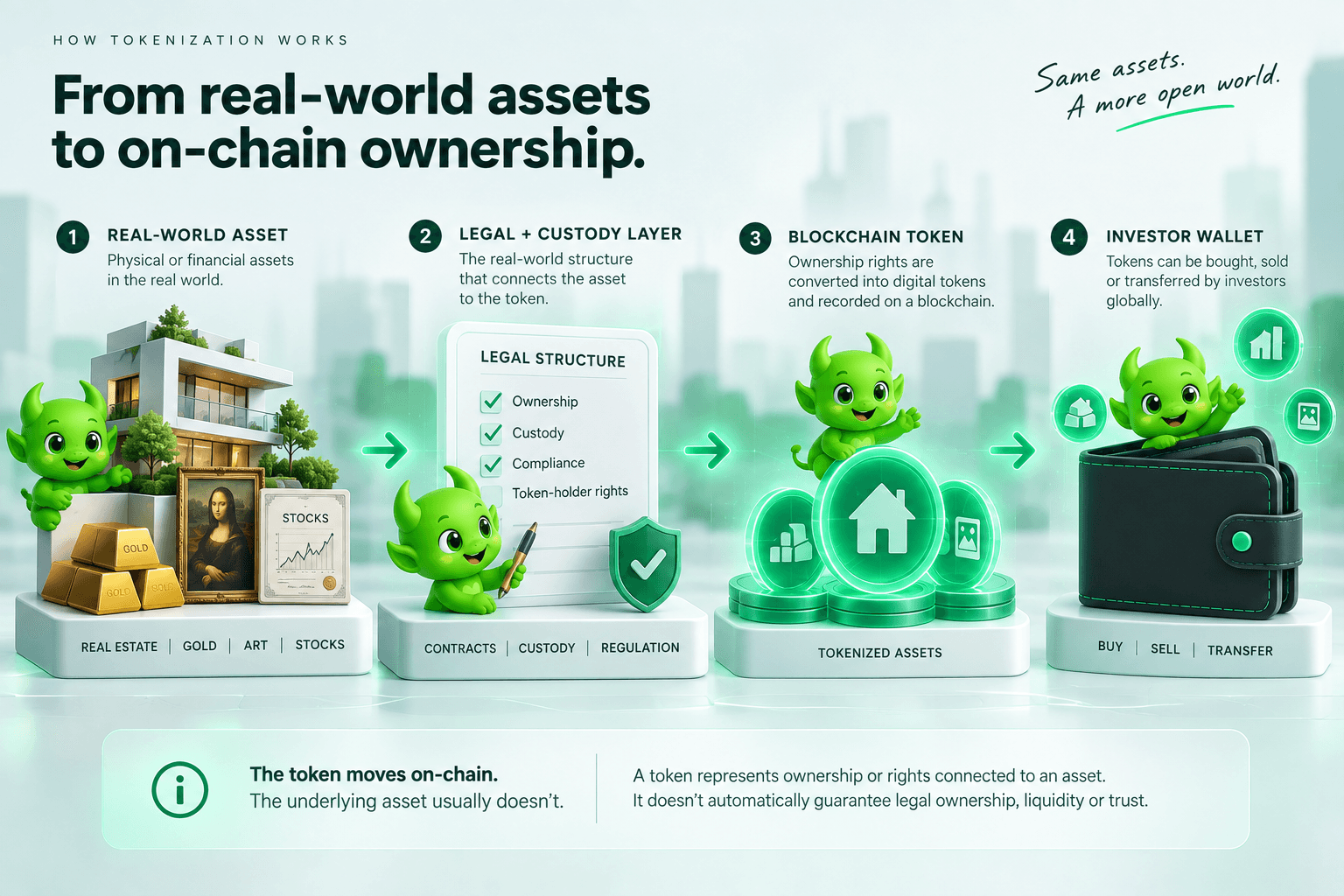
Instead of physically moving the gold every time someone buys or sells a portion digital tokens are created. Each token represents ownership of a specific amount of gold. When ownership changes the token moves from one wallet to another. The gold remains safely stored. The ownership record changes.
Blockchain technology acts as the ledger that tracks these transactions. This creates transparency because ownership records are publicly verifiable and difficult to alter. In practice the process generally follows four steps —
An asset is identified. 2. Ownership rights are converted into digital tokens. 3. Tokens are recorded on a blockchain. 4. Investors buy, sell or transfer those tokens. The result is a more flexible ownership structure.
One thing worth understanding clearly the token moves on-chain. The underlying asset usually doesn't.
The Rise of Real-World Asset Tokenization
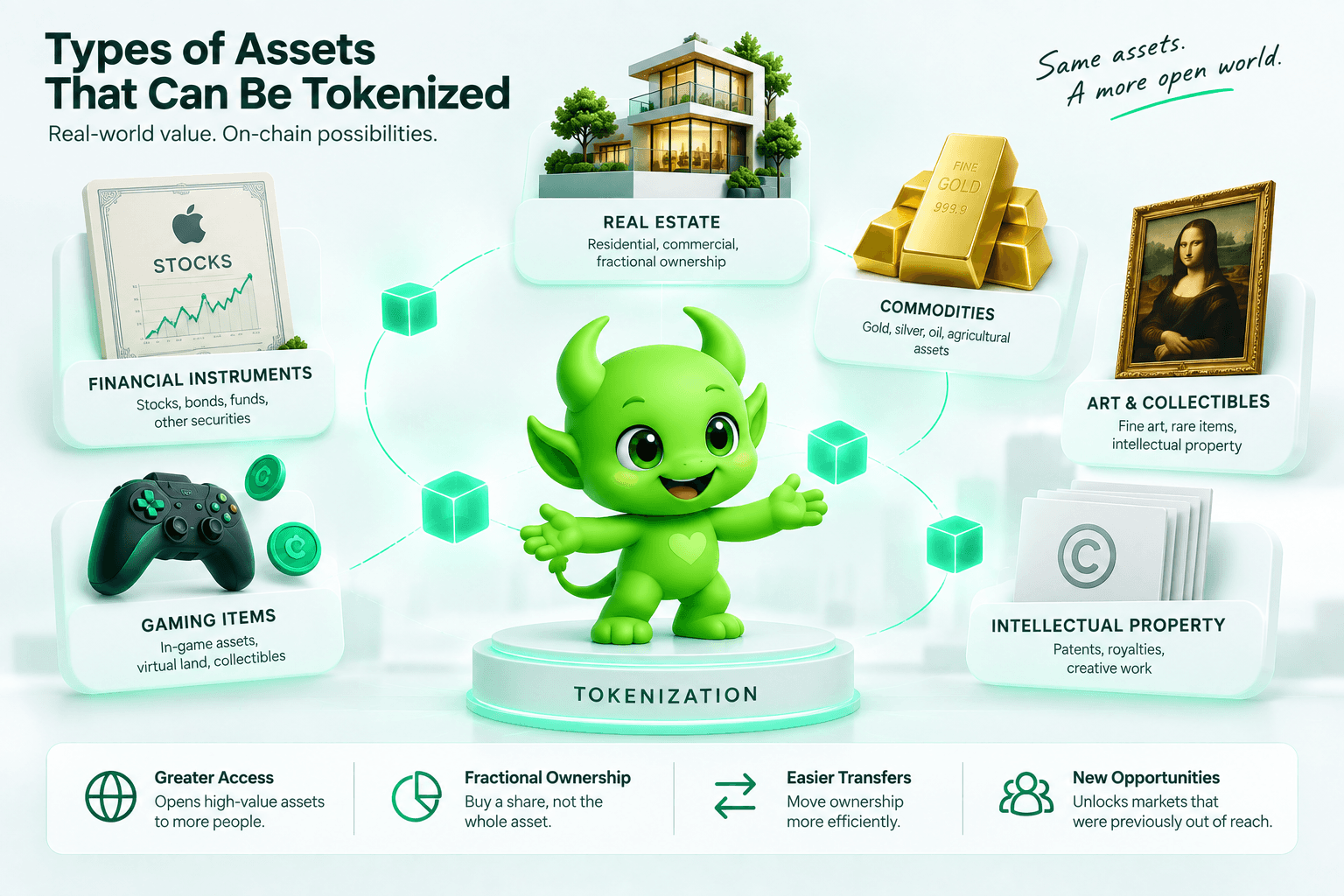
One of the most significant developments in crypto today is real-world asset tokenization often called RWA tokenization. For decades many investments were available only to wealthy individuals or institutions. Tokenization changes that. Instead of purchasing an entire asset investors can purchase fractions of it. This concept is known as fractional ownership.
Imagine a commercial building worth $10 million. Most people cannot buy it outright. But if the building is tokenized thousands of investors may each own a small share. The same principle applies across numerous asset classes.
Real Estate
Real estate is one of the most widely discussed tokenization examples. Properties can be divided into digital shares allowing investors to participate with smaller amounts of capital. This creates access that previously did not exist for most retail investors.
Gold
Tokenized gold allows investors to gain exposure to physical gold without storing or transporting it. Each token typically represents ownership of a specific amount of the underlying metal held in secure custody. Gold ETFs already exist.
Stocks and Financial Assets
Traditional securities can also be tokenized. This may improve efficiency, reduce settlement times and increase accessibility for investors around the world. Financial institutions are actively exploring tokenized bonds, securities and investment products.
The broader goal remains the same : increase participation while reducing friction. This also removes a lot of corrupted systems in between, but that is a very tricky topic to get started on which is also why governments are against this.
Types of Tokenization
Not all tokenized assets are the same. Here's what actually differs.
Real-World Asset Tokenization
This involves physical or traditional financial assets real estate, gold, bonds, stocks, commodities. These assets already exist in the real world. Blockchain creates a digital representation of ownership.
Digital Asset Tokenization
The second category involves purely digital assets. This is where NFTs become important. A non-fungible token represents ownership of a unique digital item. Unlike cryptocurrencies which are interchangeable NFTs are distinct each one represents something different.
Examples include digital art, collectibles, virtual land, gaming assets and music rights. While both categories use blockchain and tokenization the assets they represent are fundamentally different. One represents something physical or financial. The other represents something that exists only digitally.
Benefits of Tokenization
The reason tokenization attracts so much attention is because it addresses several longstanding problems in traditional markets.
Fractional Ownership
Historically many valuable assets were inaccessible to ordinary investors. Tokenization allows ownership to be divided into smaller units. Instead of buying an entire property investors can buy a fraction. This dramatically lowers the barrier to entry. Many say this will bridge the gap between the rich and poor although we do not know how true that stands at.
Greater Accessibility
Investment opportunities become available to a broader audience. People no longer need massive amounts of capital to participate in asset classes that were previously restricted to institutions and high-net-worth individuals.
Improved Liquidity
Selling a building can take months. Selling a tokenized share of that building could potentially happen much faster. Tokenization can make an asset easier to trade. But it cannot guarantee there will always be buyers for it. Liquidity depends on real market demand not just the existence of tokens.
Transparency
Blockchain records provide clear ownership histories. Transactions can be verified without relying entirely on centralized databases. For investors this can increase trust and accountability.
Real-World Examples of Tokenization
Tokenization is no longer just theory. It is already happening.
Several real estate platforms allow investors to purchase fractional ownership in properties through blockchain-based tokens. Tokenized gold products have emerged combining precious metals with blockchain infrastructure. Financial institutions are actively exploring tokenized bonds and securities.
Many experts believe this trend could eventually transform large segments of traditional finance. The reason is straightforward tokenization offers efficiency improvements that many industries find difficult to ignore.
Tokenization in Gaming
Gaming represents one of the most fascinating tokenization use cases. Traditionally players spend money on digital items that remain controlled entirely by game developers. If a game shuts down those assets may disappear.
Tokenization changes the ownership model.
Imagine purchasing a rare sword in a game. Instead of existing only inside the game's database the item becomes an NFT. The token can be held in your wallet and depending on how the game is designed may be transferable or traded outside the game's own marketplace.
That doesn't automatically mean the item will work across different games or applications. Developers still have to support it. But the ownership model shifts from the game developer holding everything to the player potentially holding a token representing their asset.
NFTs in gaming have created entirely new digital economies where players can genuinely own virtual assets rather than simply licensing access to them from a developer.
This gaming tokenization model represents one of the most significant intersections between blockchain technology and mainstream entertainment.
Why Tokenization Matters
At its core tokenization is about ownership.
For centuries ownership has been managed through paper records, centralized databases, legal contracts and intermediaries. Blockchain introduces an alternative ownership can be represented digitally, verified globally and transferred more efficiently.
This creates opportunities for both investors and businesses. It also connects traditional finance with the broader crypto ecosystem.
In many ways tokenization serves as a bridge between physical assets and digital infrastructure. When people first heard about the internet many thought it was simply a faster way to send messages. Few realized it would transform commerce, media, communication and daily life.
Tokenization may be following a similar path. If information can move digitally, ownership can too. The power will be with the people in place of the systems. It would refine how we conduct magically.
Risks and Limitations of tokenization
The part nobody talks about honestly enough.
Regulatory Uncertainty
Laws governing tokenized assets continue evolving. Different countries apply different rules. Whether token holders have legally enforceable rights to the underlying asset depends entirely on how the structure is set up and what jurisdiction governs it. Regulation remains one of the biggest hurdles facing widespread adoption.
Adoption Challenges
Technology alone is not enough. Businesses, investors and institutions must be willing to embrace new systems. Adoption takes time and the infrastructure connecting traditional finance with blockchain is still being built.
Technical Risks
Smart contracts, blockchain networks and digital wallets introduce technological risks. Bugs in smart contract code can create vulnerabilities. Security remains a critical consideration for any tokenized asset platform.
Market Acceptance
Some investors still prefer traditional ownership structures. Tokenization will need to prove its advantages consistently to achieve mainstream acceptance. High yields or accessibility promises without genuine liquidity or legal clarity will eventually disappoint.
10BIT | Take
Creating the token might be the easiest part of tokenization. The harder question is what happens when that token meets the real world.
If a token says you own part of a building someone still has to legally own that building. Someone has to maintain it. The token holder's rights have to be defined somewhere beyond the blockchain. And when you want to sell or redeem your share the system connecting the blockchain to the actual property has to work.
Blockchain can make ownership records easier to divide, verify and transfer. It can't make the asset behind those records trustworthy just because a token exists. That's why the future of tokenization won't depend only on better blockchains. It'll depend on whether the connection between the token and the thing it represents can actually be trusted.
The technology is genuinely interesting. The legal and custody infrastructure sitting beneath it deserves at least as much scrutiny.
Still Got Questions? FAQs for you
What is tokenization in crypto?
Tokenization in crypto is the process of representing ownership rights or exposure to a real-world or digital asset through blockchain based tokens. These tokens can represent assets ranging from property and gold to financial instruments and digital collectibles. The asset doesn't move onto the blockchain. The ownership record does.
2. What is an example of asset tokenization?
A property could be divided into thousands of blockchain based tokens with each token representing rights connected to a fraction of the asset. Tokenized gold works similarly tokens represent ownership of gold held in custody rather than physically transferring the metal. Financial instruments like bonds can also be tokenized to improve settlement efficiency and accessibility.
What are the main benefits of tokenization?
Potential tokenization benefits include fractional ownership, lower barriers to participation, easier transferability and transparent blockchain records. However liquidity, regulation and the legal rights actually attached to a token depend on how the underlying structure is built. The blockchain handles the record. Everything else still needs to work in the real world.
Related Post

Sep 9, 2026
What is DeFi and how does it work? Learn how decentralized finance uses smart contracts for trading, lending and borrowing — and understand the risks.

Aug 3, 2026
What is blockchain? Learn how blockchain works, why it matters, and how it's used beyond cryptocurrency with simple examples anyone can understand.

Sep 10, 2026
Smart contracts can move money, power DeFi and execute rules without asking anyone. But code doesn't understand intent. Here's how they work and fail.