What Is Ethereum? Why ETH Is More Than Just Another Coin
Ethereum isn't just another cryptocurrency. From smart contracts to DeFi and Layer 2s, discover what makes ETH different and whether its value can keep up.

Lofi | 10BIT

TL;DR
1. Ethereum made blockchain programmable. Smart contracts allow developers to build decentralized finance (DeFi), digital ownership systems and applications without relying entirely on centralized intermediaries.
2. ETH powers Ethereum, but its supply isn't fixed. ETH pays transaction fees, secures the network through staking and has supply dynamics shaped by new issuance and fee burning.
3. Ethereum's success doesn't guarantee ETH's investment returns. As more activity moves onto Layer 2 networks, the important question is how much economic value ultimately flows back to ETH.
Quick facts on ethereum
Details | Ethereum |
|---|---|
Native crypto | ETH |
Launch year | 2015 |
Consensus | Proof of stake |
Original whitepaper | Vitalik Buterin, 2013 |
Maximum supply | No fix cap |
Primary users | Gas fees, staking, DeFi, smart contracts |
Network scaling | Ethereum mainnet and Layer 2 networks |
What Is Ethereum and Why Was It Created?
Bitcoin introduced decentralized money. Ethereum asked a different question. What if a blockchain could do more than transfer value?
In 2013, Vitalik Buterin proposed a programmable blockchain where developers could build applications without creating a new network for every idea. Ethereum launched in 2015.
Bitcoin: Primarily designed around decentralized money and scarcity.
Ethereum: Built to support programmable transactions and applications.
ETH: The native asset used to pay network fees and help secure Ethereum.
Think of Bitcoin as a calculator and Ethereum as a smartphone. One is built around a focused purpose. The other supports an entire ecosystem of applications. That flexibility is what made Ethereum different.
How Does Ethereum Work?
Ethereum operates as a shared blockchain where applications can execute code through smart contracts. A smart contract is a program that automatically follows predefined rules. Imagine trading a digital asset without asking a traditional marketplace to process the exchange.
Smart contracts: Execute transactions according to programmed conditions.
Decentralized applications (dApps): Let users interact with blockchain-based services.
Validators: Help verify transactions and secure the network.
Gas fees: Pay for the computational resources required to process transactions.
The result is a programmable financial and application platform. But smart contracts don't magically eliminate every intermediary or risk. Developers, interfaces, oracles and other infrastructure can still matter.
How Did Ethereum Move From Mining to Staking?
Ethereum wasn't always a Proof of Stake network. Until September 2022, it relied on Proof of Work, similar to Bitcoin. Then came The Merge.
Before The Merge: Miners used computational power to help secure Ethereum.
After The Merge: Validators stake ETH to participate in securing the network.
Energy efficiency: The transition reduced Ethereum's estimated energy consumption by approximately 99.95%.
Validators earn rewards for performing their responsibilities and can face penalties for certain failures or dishonest behaviour. The Merge was a major change to Ethereum's security model.
But it didn't suddenly make Ethereum transactions cheaper or dramatically increase transaction throughput. Those are separate scaling challenges.
Why Is Ethereum So Important to DeFi and Web3?
Many blockchains support applications. Few have played a role as influential as Ethereum in developing the modern crypto ecosystem.
Decentralized finance: Protocols such as Aave and Uniswap enable lending, borrowing and trading through smart contracts.
Stablecoins: Dollar-linked tokens move through Ethereum and its scaling networks.
Digital ownership: NFTs introduced new ways to represent and transfer digital assets.
Tokenization: Financial institutions and developers are experimenting with blockchain-based securities and investment products.
DAOs and Web3: Communities and applications can coordinate activity through blockchain-based systems.
Ethereum's advantage isn't simply that it introduced smart contracts. It's the developers, applications, liquidity and infrastructure that have accumulated around them. Network effects matter. But they aren't permanent guarantees.
How Do Ethereum Gas Fees and Layer 2 Networks Work?
Running applications on a blockchain isn't free. Ethereum charges gas fees for computation and transactions. The problem? When demand for mainnet blockspace increases, fees can become expensive. Ethereum's scaling strategy increasingly relies on Layer 2 networks.
Ethereum mainnet: Provides settlement and security infrastructure.
Layer 2 networks: Process transactions more cheaply and efficiently while using Ethereum for aspects of settlement or data availability.
Rollups: Bundle transaction activity and publish relevant information or proofs back to Ethereum.
Networks such as Arbitrum, Optimism and Base are part of this broader scaling ecosystem. For users, the appeal is straightforward: cheaper transactions and more practical applications.
For ETH investors, the question is more complicated: growing Layer 2 adoption improves Ethereum's scalability, but doesn't necessarily translate into proportional economic value for ETH holders. This is where diversification helps as when the market moves the L2s move more than eth in percentage ROI terms.

How Do ETH Tokenomics and Staking Work?
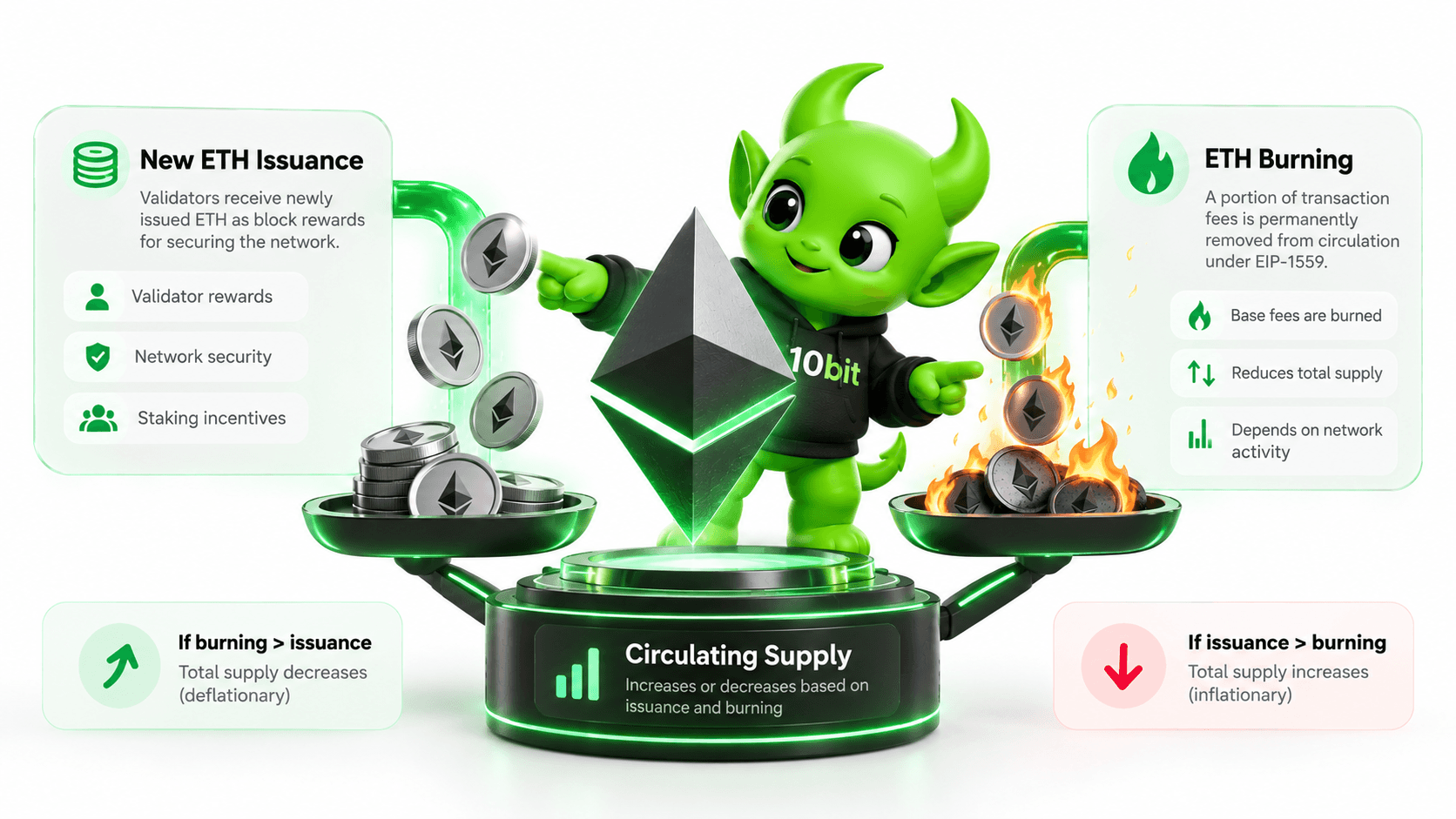
Unlike Bitcoin, ETH doesn't have a fixed maximum supply. Its supply changes through two competing mechanisms.
Issuance: New ETH is created to reward validators securing the network.
Fee burning: A portion of Ethereum's transaction fees is permanently removed from circulation.
Staking: ETH holders can participate in network security and receive rewards, directly or through staking services.
When ETH burning exceeds new issuance, supply decreases. When issuance exceeds burning, supply increases.
That means ETH isn't permanently deflationary. Its supply dynamics depend on network activity, fee demand and validator economics. Staking rewards also aren't guaranteed profits. Token price movements, service fees and staking risks still matter.
How Does Ethereum Compare With Bitcoin, Solana and Cardano?
These networks approach blockchain development differently.
Bitcoin: Focuses on decentralized money, monetary scarcity and security.
Ethereum: Emphasizes smart contracts, decentralized finance and a broader scaling ecosystem.
Solana: Prioritizes fast, inexpensive activity on its base layer.
Cardano: Uses a research-oriented development approach to programmable blockchain infrastructure.
Ethereum's biggest competitive strength is its established ecosystem. But Solana and other networks compete aggressively on speed, cost and user experience. Ethereum doesn't need to win every transaction-speed comparison. It needs developers, users and capital to keep finding reasons to build and settle activity within its ecosystem.
What Has Driven Ethereum's Price History?
Ethereum's history has been shaped by several major developments.
2015–2017: The early years. Ethereum launched, attracted developers and gained attention during the ICO boom.
2018–2022: Expansion and volatility. Crypto market cycles, DeFi growth, NFTs and The Merge transformed Ethereum's role.
2023–2026: Scaling and institutional interest. Layer 2 adoption, investment products and network upgrades became increasingly important to the ETH narrative.
ETH has experienced dramatic rallies and painful drawdowns throughout its history. Its price reflects more than blockchain adoption. Liquidity, investor expectations, regulation and broader market conditions all matter. A growing ecosystem doesn't guarantee a rising token price.
What Actually Gives ETH Value?
This is where Ethereum becomes more interesting as an investment. ETH isn't a traditional company share. Owning it doesn't entitle investors to Ethereum's profits.
Its value proposition comes from several sources.
Gas demand: ETH is used to pay for transactions and computation on Ethereum.
Staking: ETH is committed to securing the network.
Fee burning: Network activity can reduce circulating supply through the base-fee burn.
Liquidity and collateral: ETH is widely used throughout decentralized financial markets.
But there's a catch. Ethereum applications can become enormously successful without every dollar of economic activity flowing directly to ETH holders.
Layer 2 scaling makes that relationship even more important to understand. Ethereum can grow. Its applications can grow. And ETH can still capture less value than investors expected.
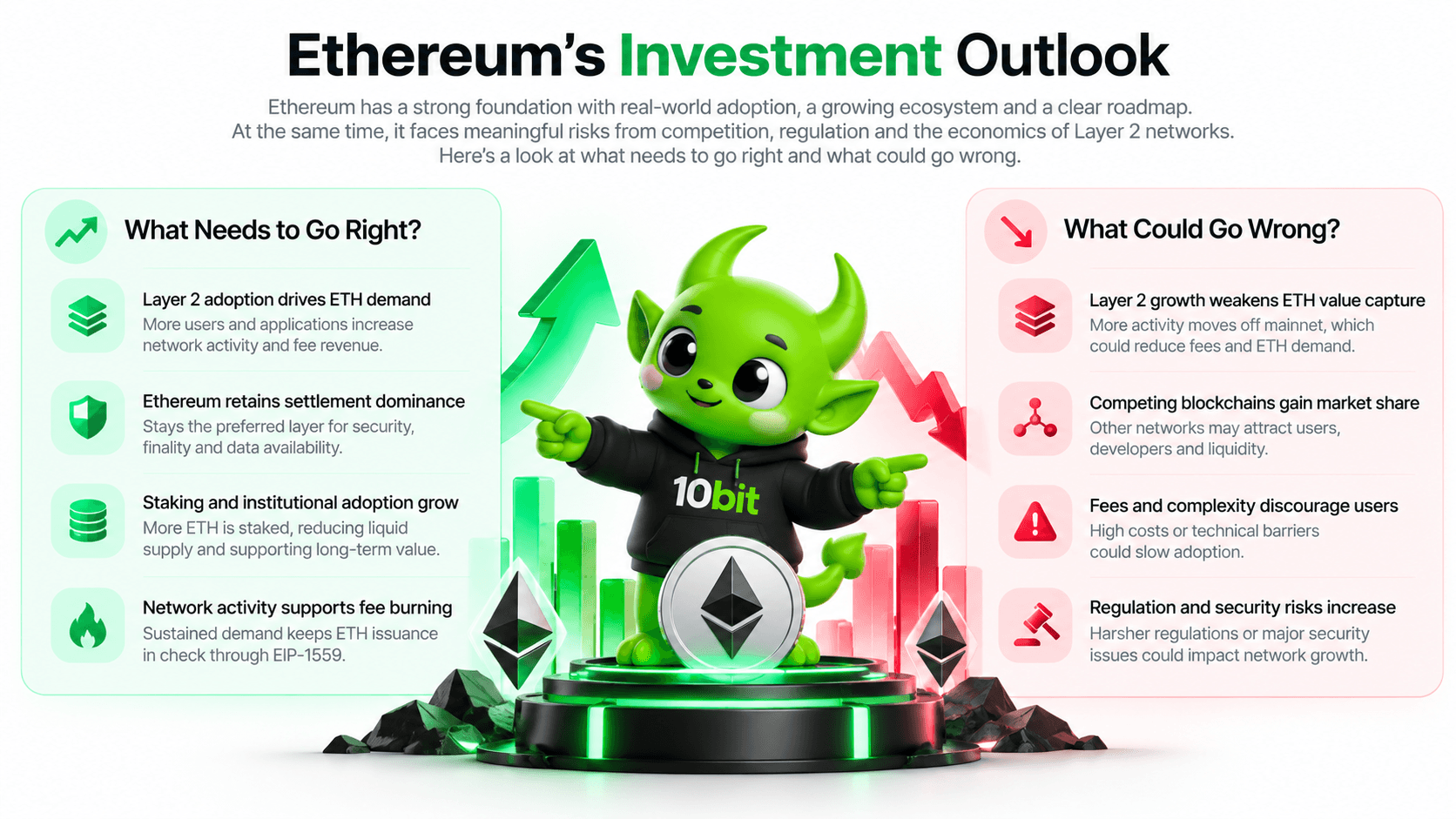
Ethereum's Investment Outlook: What Could Go Right or Wrong?
Ethereum's long-term investment case depends on more than growing network adoption. Layer 2 scaling, institutional demand and ETH fee burning could strengthen its position, while competition, regulation and weak value capture remain significant risks. Here's what needs to go right for ETH and what could undermine its investment thesis.
What Are the Biggest Risks of Investing in Ethereum?
Volatility: ETH can experience severe price declines even when network development continues.
Technical risks: Smart contract vulnerabilities, bridge failures and scaling infrastructure introduce different security assumptions.
Staking risks: Validator penalties, service-provider failures and liquidity constraints can affect returns.
Competition and regulation: Ethereum operates in a rapidly changing technological and legal environment.
10BIT | Take
TRON started with dreams of changing the internet. It ended up becoming useful for moving dollars around it. There's something almost funny about that. The original pitch was empowering content creators, but stablecoin transfers became one of the network's most important real-world uses. Sometimes the market finds a better use for technology than its founders originally imagined.
Millions of transactions don't automatically make TRX a great investment. Users may love transferring USDT without caring much about TRX itself. Staking, network resources and token burning connect activity to TRX, but investors still need to understand how much demand those mechanisms actually create.
TRON's future depends less on telling a new story and more on defending the one it already has. If stablecoin usage remains strong, resource demand grows and the network stays competitive, TRX has a meaningful investment thesis. If that activity migrates elsewhere, being an early player in blockchain payments won't be enough.
Sources and Further reading
1. TRON Developer Documentation : Consensus and DPoS Learn more
2. TRON Developer Documentation : Bandwidth and Energy Learn more
3. TRON Developer Documentation : Super Representatives Learn more
4. TRON : Official Developer Hub Learn more
Related Post

Sep 22, 2026
Bitcoin has no company, CEO, profits or dividends. So why is it worth anything? Explore how Bitcoin works and what gives BTC its value.

Sep 20, 2026
What is Solana and how does SOL work? Explore its speed, Proof of History, ecosystem, tokenomics, risks and the investment thesis behind SOL.

Sep 23, 2026
Could Hyperliquid have a Solana-like breakout? Explore why its ecosystem is growing, how HYPE captures value, and what could derail its rise.