Bitcoin Has No Point
Bitcoin has no company, CEO, profits or dividends. So why is it worth anything? Explore how Bitcoin works and what gives BTC its value.

Lofi | 10BIT

Bitcoin in a Nutshell (TL;DR)
Bitcoin is the world's first decentralized digital currency. Launched in 2009 it allows people to transfer value directly over the internet without relying on a bank, government or financial intermediary.
Its supply is capped at 21 million BTC. New Bitcoin enters circulation only through mining. No central authority can change those rules.
Bitcoin's investment thesis doesn't rest on company earnings or future cash flows. It rests on whether enough people continue to value a scarce digital asset with predictable rules and no central issuer.
Key Takeaways
Bitcoin was designed to move value between people without banks or intermediaries. Its blockchain records every transaction publicly and makes altering history extremely difficult.
Only 21 million Bitcoin will ever exist. That scarcity is enforced by network consensus not by any company or government and changing it would require the entire network to accept fundamentally different rules.
Bitcoin doesn't generate profits or pay dividends. Its value comes from people continuing to trust its monetary rules, security and scarcity. The investment question is whether enough of them will keep doing that.
Bitcoin Has No Company or Cash Flow. So Why Is It Worth Anything?
Imagine trying to send money to a friend living on the other side of the world.
You open your banking app, enter the details and hit send. Sounds simple enough. But behind that transaction sits a complex web of banks, payment processors, regulations, settlement systems and fees. Depending on where your friend lives the transfer could take hours, days or longer.
Now imagine money moving directly from one person to another. Just as easily as sending an email. That was the idea behind Bitcoin.
Today Bitcoin is the largest cryptocurrency in the world and one of the most discussed financial assets of the 21st century. Some people view it as digital gold. Others see it as the future of money. Critics call it volatile and speculative.
Regardless of where you stand there is no denying that Bitcoin changed how the world thinks about money.
Bitcoin Started With a Financial Crisis
To understand Bitcoin we need to go back to 2008.
The world was in the middle of a devastating financial crisis. Major banks collapsed, governments stepped in with bailouts and public trust in financial institutions reached historic lows.
During this period a mysterious individual or group operating under the name Satoshi Nakamoto published a nine-page document titled Bitcoin: A Peer-to-Peer Electronic Cash System.
The proposal was straightforward. Instead of relying on banks to verify and process transactions people could send money directly to each other through a decentralized network.
Quick Facts
Quick Facts | BTC |
|---|---|
Network | Bitcoin |
Creator | Satoshi Nakamoto |
Launched | 2009 |
Maximum supply | 21 million |
Consensus | Proof of work |
Native asset | BTC |
Primary purpose | Peer-to-peer digital money and scarce digital asset |
New supply | Issued through mining |
If Nobody Controls Bitcoin, How Does It Work?
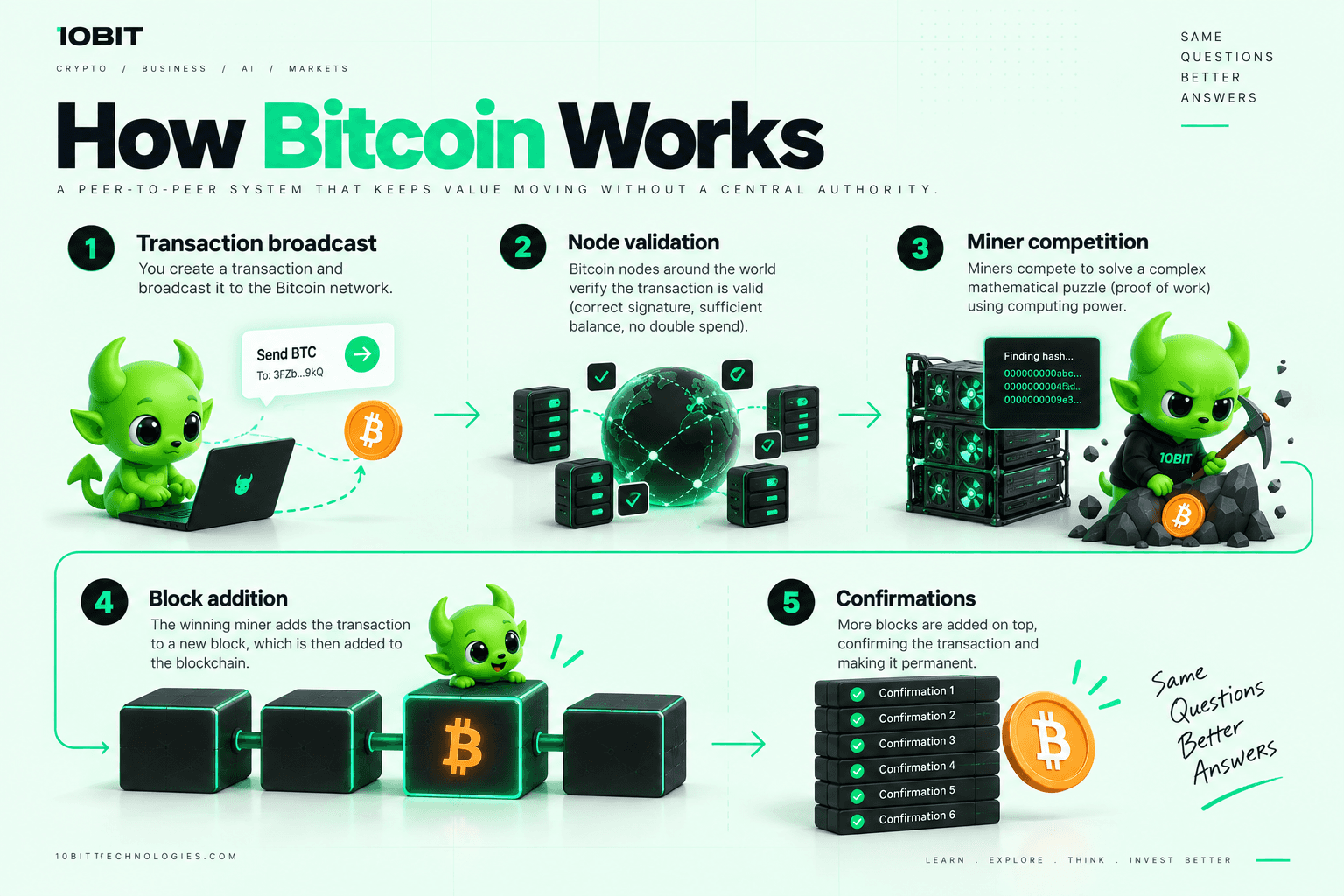
Bitcoin uses Proof of Work to secure the network. Miners use specialized computers to compete for the right to add the next block, receiving newly issued BTC and transaction fees when successful.
That computation makes rewriting Bitcoin's history expensive. The energy consumption is controversial, but it isn't incidental to the design: Proof of Work deliberately attaches a real-world cost to attacking the ledger.
Today billions of dollars worth of Bitcoin transactions are processed through this system making it one of the most secure financial networks ever created.
How Bitcoin Mining Works
If the blockchain is the record book miners are the people responsible for maintaining it.
Under this proof of work system miners compete to solve complex mathematical problems using powerful computers. Proof of Work deliberately consumes computational resources to make attacking or rewriting the blockchain ledger expensive. The first miner to solve the puzzle earns the right to add a new block of transactions to the blockchain. As a reward they receive newly created Bitcoin.
This process is known as Bitcoin mining.
In the early days people could mine Bitcoin using ordinary laptops. Today Bitcoin mining is an entirely different industry. Massive facilities filled with specialized hardware operate around the clock consuming significant amounts of electricity to secure the network.
This has sparked debates around energy consumption. The important point is that Proof of Work's energy use is not accidental. It's the mechanism that makes rewriting Bitcoin's history prohibitively expensive for any attacker.
Mining remains the mechanism that keeps Bitcoin secure and decentralized.
Why Bitcoin's Supply Makes It Different
Most traditional currencies can be printed whenever central banks choose to increase the money supply. Bitcoin works differently.
Only 21 million Bitcoin will ever exist. As of 2026 more than 19 million have already been mined leaving only a small percentage yet to enter circulation.
The supply limit is enforced by Bitcoin's protocol and network consensus rules. Changing it would require the entire network to accept fundamentally different rules, not simply a company or government deciding to issue more.
This scarcity becomes even more significant because of an event called the Bitcoin halving.
Approximately every four years the reward miners receive for adding a block is reduced by 50%. Imagine a gold mine that suddenly starts producing half as much gold every few years while demand continues growing. Basic economics suggests that reduced new supply combined with sustained or growing demand could influence price.
This is one reason investors often compare Bitcoin to precious metals.
Why Does Bitcoin Have Value?
Bitcoin doesn't generate profits. It doesn't pay dividends. There is no company behind it promising future cash flows. The Bitcoin thesis starts with scarcity but scarcity alone isn't enough. Plenty of scarce things are worthless.
Bitcoin's value depends on people continuing to trust its monetary rules, network security, liquidity and ability to transfer ownership without relying on a central issuer.
Gold has been used as a store of value for thousands of years because it is scarce, difficult to produce and widely recognized across the world. Bitcoin shares many of those characteristics but in digital form. Unlike gold Bitcoin can be transferred globally within minutes without physical movement.
This is why many investors refer to Bitcoin as digital gold.
In recent years institutional investors, hedge funds, publicly traded companies and asset managers have added Bitcoin to their portfolios. Bitcoin ETFs approved in major markets have made institutional-grade access to BTC significantly easier. This growing participation has strengthened the narrative that Bitcoin is evolving into a modern store of value.
How People Use Bitcoin Today
Although Bitcoin began as a peer-to-peer payment system its use cases have expanded significantly.
The most common Bitcoin use case today is long-term wealth preservation. Many investors purchase Bitcoin with the expectation that its scarcity and growing adoption will increase its value over time.
Others use Bitcoin for international transfers. Traditional cross-border payments involve delays and fees. Bitcoin allows direct transfers between users anywhere in the world.
In countries experiencing high inflation Bitcoin has emerged as an alternative store of value. When local currencies lose purchasing power some individuals turn to Bitcoin to protect their savings.
Businesses, payment providers and financial institutions continue exploring ways to integrate Bitcoin into global commerce.
Bitcoin vs Ethereum and Gold
Neither comparison settles the question. They just clarify what you're actually evaluating.
For a full comparison of Bitcoin and Ethereum read our dedicated Bitcoin vs Ethereum guide. But here is the short version.
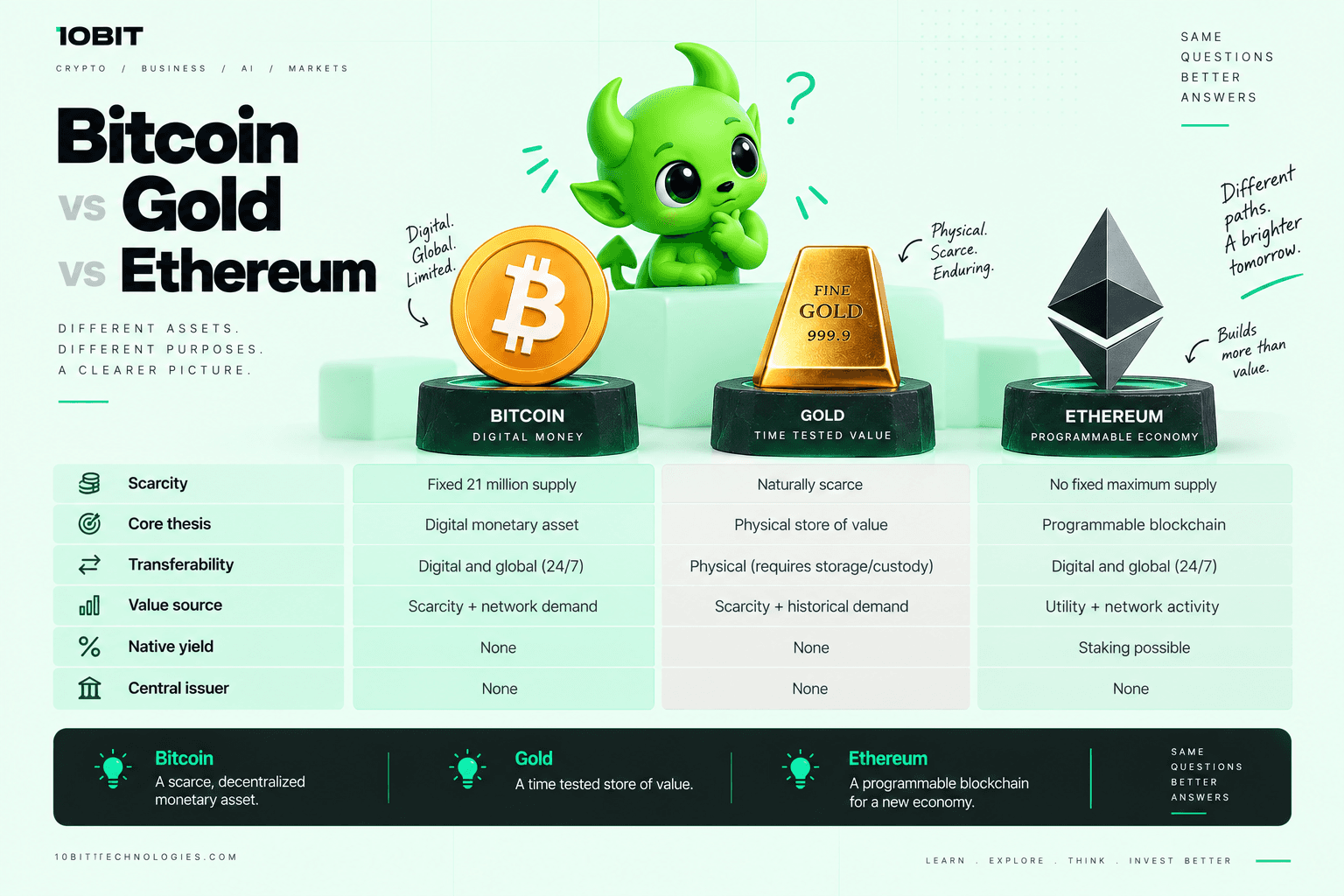
Bitcoin, gold and Ethereum can all be treated as investable assets, but their value comes from very different places.
Bitcoin's thesis centers on digital scarcity and monetary demand. Gold relies on physical scarcity and thousands of years of accumulated trust. Ethereum derives more of its value from being useful infrastructure for applications and economic activity.
The Story Behind Bitcoin's Price
Few assets in modern history have experienced a journey as dramatic as Bitcoin.
In its earliest days Bitcoin traded for fractions of a cent. A famous example occurred in 2010 when a programmer spent 10,000 Bitcoin on two pizzas. At current valuations that transaction is worth more than most people will earn in a lifetime.
Three meaningful chapters define Bitcoin's price history.
From 2009 to 2017 the experiment became an asset. Bitcoin moved from a niche technical project to something with a real market price, retail interest and its first wave of institutional attention.
From 2018 to 2022 Bitcoin experienced boom, serious institutional attention and brutal cycles. It reached then-record highs before losing more than half its value more than once.
From 2023 to 2026 Bitcoin's market role changed again. Spot Bitcoin ETFs were approved in major markets giving institutional investors direct regulated access. Bitcoin crossed $100,000 for the first time. The asset class became harder to categorize as simply speculative.
Today millions of people monitor Bitcoin price today and Bitcoin USD charts to track market movements. Factors that influence price include institutional demand, government regulation, macroeconomic conditions, interest rates and overall investor sentiment.
What Has to Go Right and What Could Break the Bitcoin Thesis
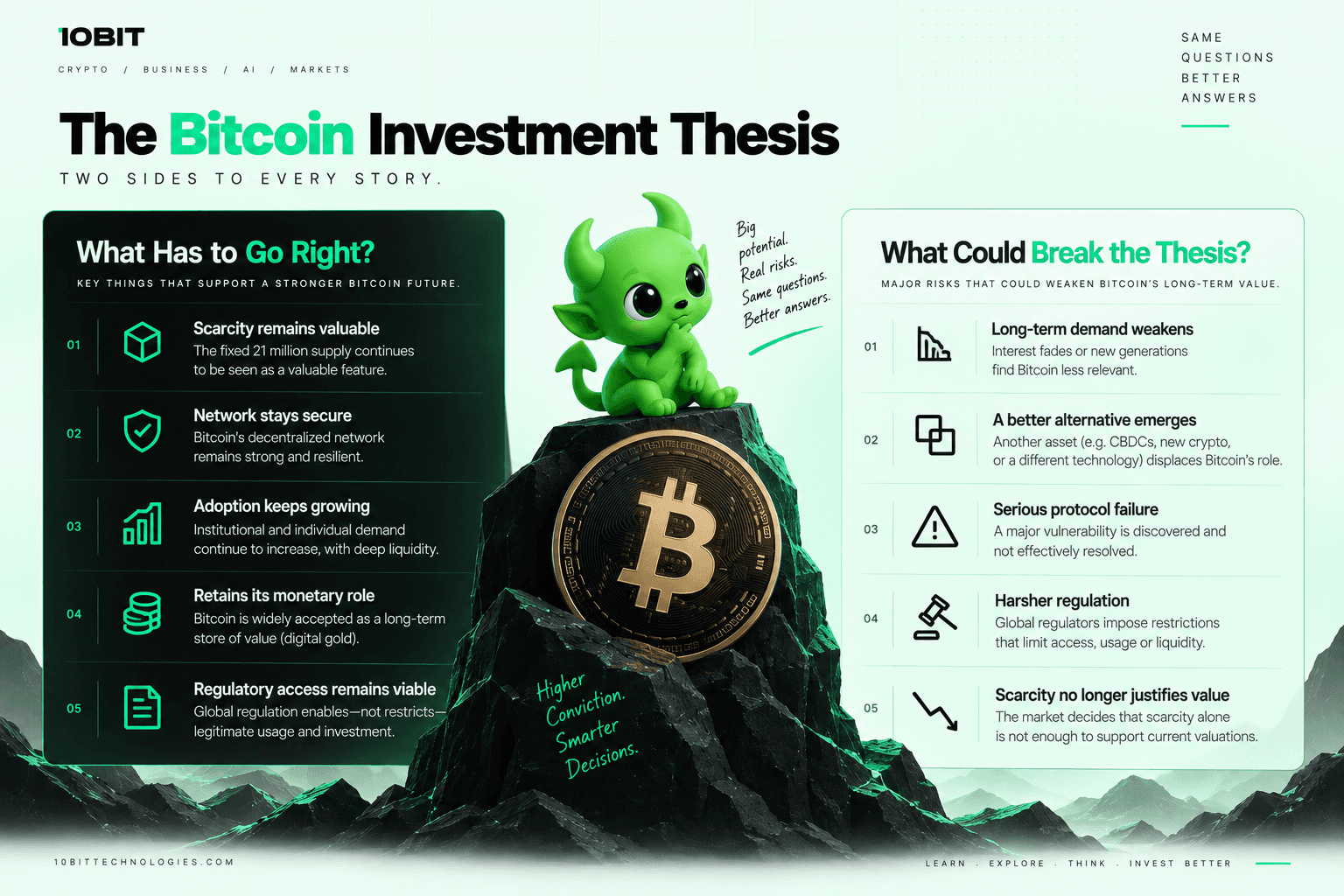
Bitcoin's investment case ultimately depends on more than its 21 million supply cap. Scarcity needs sustained demand, the network needs to remain secure, and Bitcoin needs to retain enough liquidity, accessibility and monetary relevance for people to keep treating it as a valuable asset.
The opposite is also true. Weakening demand, technological failure, stronger alternatives or restrictions on access could undermine that thesis.
Risks Investors Should Understand
The most obvious risk is volatility. Bitcoin can experience dramatic price swings within short periods. Drops of more than 50% have happened multiple times across Bitcoin's history. Investors who cannot manage that kind of fluctuation should understand it clearly before entering.
Regulatory uncertainty remains a factor. Governments around the world continue refining policies related to cryptocurrency ownership, taxation and trading as it can cut them out of a lot of processes across the globe. Changes in regulation can significantly impact sentiment and access.
Market cycles can be equally challenging. Bull markets generate excitement and draw in new participants near the top. Bear markets test conviction and patience in ways that are much harder to anticipate in advance.
Buying, Tax and Storage in India
For Indian investors, Bitcoin can be purchased through crypto platforms that support INR deposits after completing applicable KYC requirements. Before choosing a platform, consider its security practices, fees and compliance with applicable Indian requirements.
Bitcoin and other virtual digital assets are subject to India's VDA tax rules. If you're investing, understand the applicable tax treatment and record-keeping requirements rather than treating tax as an afterthought.
Once purchased, BTC can either remain with a custodian or be moved to a self-custody wallet. Whichever method you choose, protecting private keys and recovery phrases is critical.
Read: How to Buy Cryptocurrency →
Read: How Crypto Wallets Work →
10BIT | Take
Bitcoin is a genuinely unusual asset. Most things people invest in have an underlying business. Earnings. Management teams. Products. Future cash flows. Bitcoin has none of that.
What it has is a network of people who have agreed that a scarce digital asset with predictable rules and no central issuer is worth owning. And a track record of that agreement surviving market crashes, regulatory pressure, media obituaries and constant skepticism for more than fifteen years.
Whether that continues is the only question that matters.
Not the price chart. Not the halving schedule. Not what any particular analyst says about the next cycle. The question is whether enough people will keep believing that digital scarcity is worth something.
So far the answer has been yes. But that answer is always being renewed and never permanently settled. That's what makes Bitcoin interesting and genuinely difficult to evaluate at the same time.
3 Things You May Have Missed
Bitcoin's total supply cap of 21 million is well known. Less discussed is what happens as the final Bitcoin approaches.
Bitcoin miners currently earn both block rewards and transaction fees. As issuance continues declining through successive halvings transaction fees will need to provide sufficient economic incentive for miners to continue securing the network.
Whether fee revenue can sustain a healthy mining industry as block rewards approach zero is an open question. It won't matter for decades but it's one of the more genuinely uncertain long-term aspects of Bitcoin's design.
Worth knowing before assuming Bitcoin's security model is permanently settled.
Still Got Questions? FAQs
Can Bitcoin be hacked or shut down?
The Bitcoin network itself has never been successfully hacked. Its security comes from the computational work required to rewrite the blockchain's history. Individual wallets, exchanges and applications built on top of Bitcoin can be compromised but the base protocol has remained secure since launch. Shutting Bitcoin down would require stopping every node simultaneously across the world which has no realistic mechanism.
What happens when all 21 million Bitcoin are mined?
A MEGA PUMP TO $1 MILLION. Kidding. The last Bitcoin isn't expected to be mined until around 2140. As issuance falls, miners will increasingly rely on transaction fees to secure the network. Whether those fees will be enough remains an open question.
Why does Bitcoin have value if it doesn't produce anything?
BITCOIN IS THE REPRESENTATION OF THE PEOPLE VS GOVERNMENTS. Bitcoin has no profits, dividends or cash flow. Its value comes from people choosing to value its scarcity, predictable rules and lack of a central issuer in order for cleaner systems. But scarcity alone means nothing if nobody wants it.
We do our research but simplify it for you -
Satoshi Nakamoto Bitcoin: A Peer-to-Peer Electronic Cash System
Bitcoin Whitepaper
Bitcoin Developer Documentation : Blockchain & Proof of Work
Bitcoin Developer GuideU.S. SEC : Approval of Spot Bitcoin Exchange-Traded Products, January 2024
SEC Spot Bitcoin ETP Statement
Related Post

Sep 7, 2026
Bitcoin vs Ethereum: what's actually different? Compare their purpose, supply, technology, use cases and risks — and understand what each was built to do.

Aug 3, 2026
What is blockchain? Learn how blockchain works, why it matters, and how it's used beyond cryptocurrency with simple examples anyone can understand.

Sep 10, 2026
Smart contracts can move money, power DeFi and execute rules without asking anyone. But code doesn't understand intent. Here's how they work and fail.