Your Crypto Isn't Actually Inside Your Wallet
Your crypto isn't actually inside your wallet. Here's what a crypto wallet really stores, how private keys and recovery phrases work, and how to keep your assets secure.

Lofi | 10BIT

Crypto Wallets Explained : Your Crypto Isn't Where You Think It Is
If you're getting into crypto, one term you'll hit immediately is crypto wallet. And the name is slightly misleading. Most beginners think a crypto wallet stores cryptocurrency the same way a physical wallet stores cash. It doesn't.
Your crypto exists on the blockchain. Your wallet holds the credentials that let you control and interact with it. That distinction matters more than most people realise. Because in self-custody crypto control of the keys means control of the assets. Full stop.
Key Takeaways
A crypto wallet doesn't store your crypto it stores the keys that prove you control it. Your actual assets live on the blockchain.
Custodial wallets are convenient but someone else holds your keys. Self-custody wallets give you full control and full responsibility.
Your recovery phrase is the most important thing in self-custody crypto. Lose it along with your wallet access and your funds are gone. Forever. No customer support to call.
What Is a Crypto Wallet
A crypto wallet is a tool that allows you to access and control your digital assets.
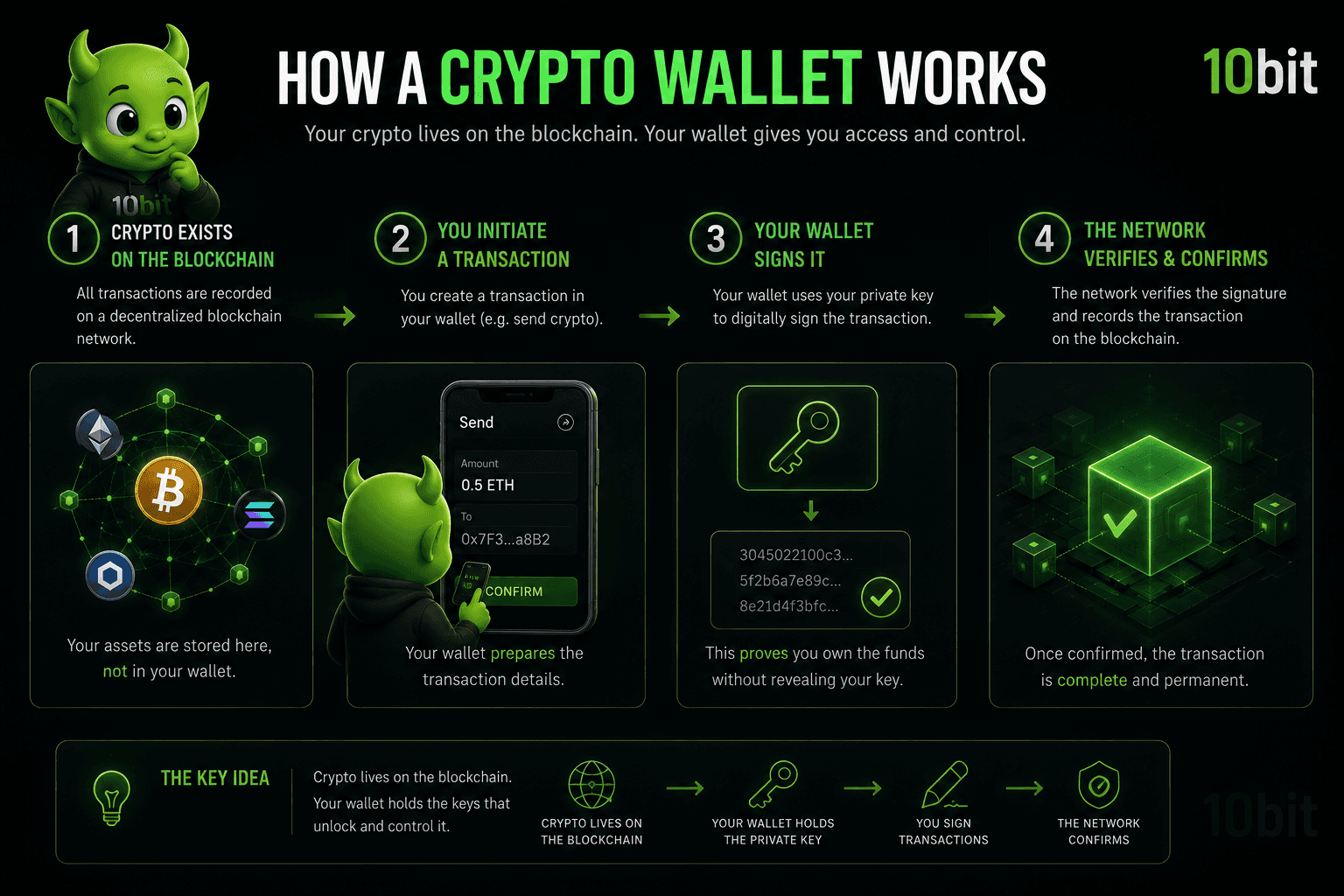
It works by storing your private key, not your coins. Your cryptocurrency remains on the blockchain, while your wallet acts as the gateway that allows you to interact with it.
A simple way to think about it is this. Imagine your crypto is stored in a global digital vault. Your wallet is not the vault itself, but the key that unlocks your portion of it. This is why control matters so much. If you have your private key, you have full access to your crypto. If you control the private keys, you control the crypto. And if you lose access to your wallet, your recovery phrase may allow you to restore it. Lose both without a backup and those funds may become permanently inaccessible.
This is not just theoretical. It is estimated that nearly 20 percent of all Bitcoin in circulation is permanently lost, largely because people misplaced their private keys or access credentials. That represents billions of dollars that still exist on the blockchain but can never be accessed.
How Do Crypto Wallets Work
Every crypto wallet is built around two key elements: the public key and the private key.
Your public key works like an address. It is what you share with others when you want to receive funds. For example, if someone is sending you Ethereum or Bitcoin, they use your public wallet address.
The private key, on the other hand, is what gives you ownership. It allows you to sign transactions and move your funds. This key must remain confidential at all times.
When you send crypto, your wallet uses your private key to digitally sign the transaction. The network then verifies that signature and records the transaction on the blockchain. This process happens within seconds or minutes and does not require a bank or intermediary.
The importance of this system becomes very clear when things go wrong. There have been multiple cases where individuals lost access to large amounts of cryptocurrency simply because they lost their private key. One widely reported case involved a programmer who lost access to over 7,000 Bitcoin because he forgot his password, locking away hundreds of millions of dollars permanently.
Types of Crypto Wallets
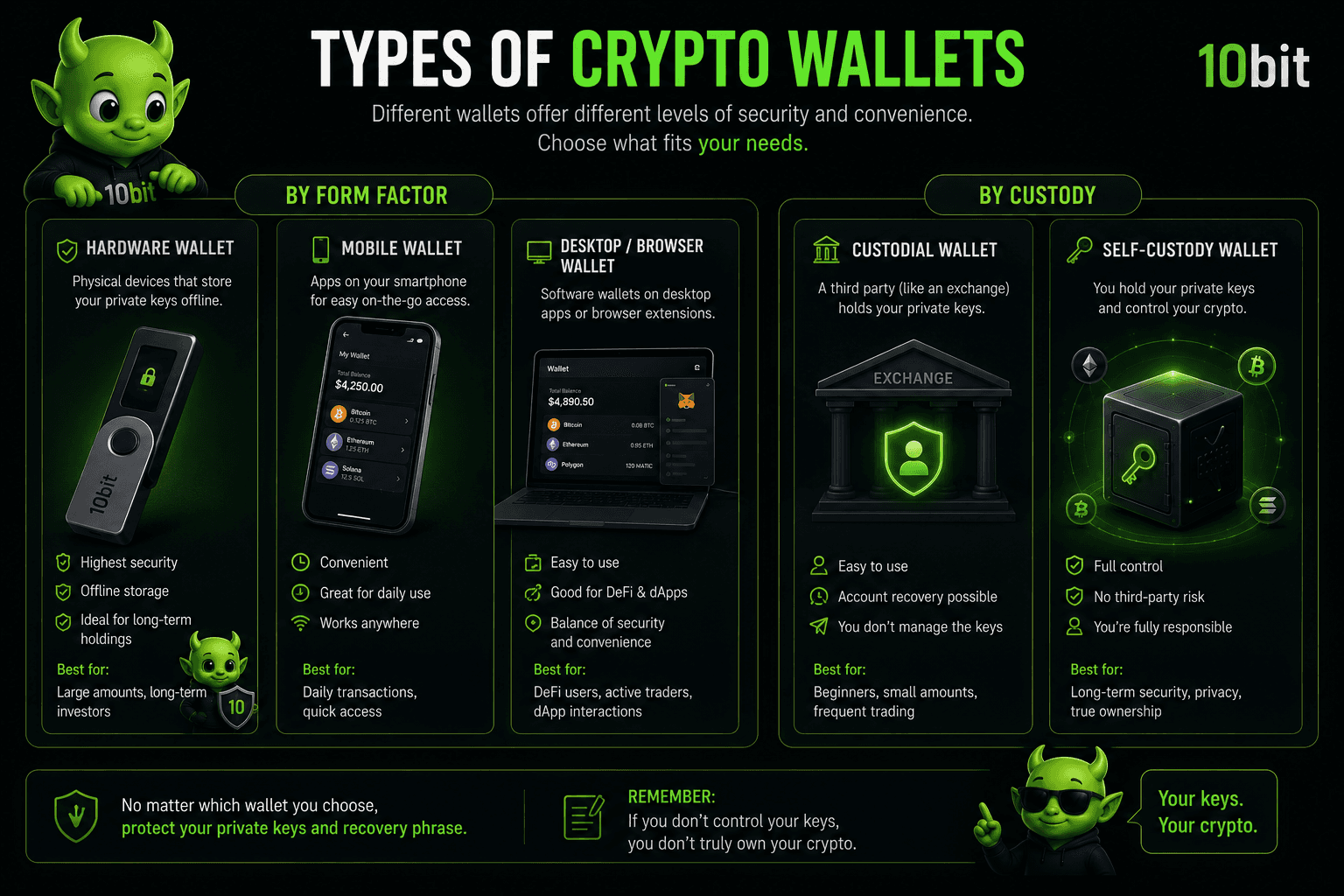
Not all wallets are equal. Here's what actually differs. There are two main ways to store crypto — hardware wallets and software wallets.
Hardware wallets store your private keys offline on a physical device. No internet connection means significantly less exposure to hacking attempts. Best for long term holders with larger amounts.
Software wallets live on your phone, desktop or browser. Convenient for regular transactions. More exposure to online threats. Then there's the more important distinction — custodial vs self-custody.
Why Crypto Wallets Matter
Crypto wallets are not just tools. They define ownership in the crypto ecosystem.
In traditional finance, your money is held by banks. In crypto, your wallet gives you direct control without any intermediary. This is one of the main reasons cryptocurrency is considered decentralized.
This level of control also comes with responsibility. You are not relying on a bank to protect your funds. You are responsible for storing your private key securely and ensuring no one else can access it.
This is why understanding how to store crypto securely is essential. It is not just about convenience. It is about protecting your assets.
Risks and Safety Basics
While crypto wallets provide freedom, they also introduce risks that do not exist in traditional systems. The most important risk is losing your private key. If that happens, you lose access permanently. There is no reset option, no customer support, and no recovery process.
Security threats are also common. Phishing attacks, fake apps, and malicious links are some of the most frequent ways people lose funds. Many users have lost their crypto simply by entering their private key on a fake website.
This is why experienced users take extra precautions. They store their keys offline, avoid sharing sensitive information, and often use hardware wallets for larger amounts. Even small mistakes can have large consequences in crypto, which makes awareness and caution extremely important.
10BIT Take
A crypto wallet isn't really a wallet. It's your access point to assets that exist on a blockchain.And that's what makes self-custody both powerful and unforgiving. You can control your crypto without depending on a bank or exchange.
But that also means taking full responsibility for the keys and recovery information that control it. Crypto gives you ownership without the middleman. Just remember — removing the middleman also removes the person you'd normally call when something goes wrong.
That's the trade. Know it before you make it.
Things you may have missed
Most people think hardware wallets are unhackable. They're not. The device itself can be physically stolen. The PIN can be brute forced if weak. The recovery phrase can be photographed without you knowing.
Hardware wallets reduce online attack surface significantly. They don't eliminate human error. And human error is how most crypto actually gets lost.
The technology is secure. The weak point is always the person using it.
Still got questions? FAQ for you
Does a crypto wallet actually store my cryptocurrency?
No. Your crypto stays on the blockchain. Your wallet manages the keys that prove you control it. Think of it less like a wallet and more like a keychain.
What happens if I lose my hardware wallet?
If you have your recovery phrase backed up safely you can restore access on a new device. The crypto doesn't live on the hardware. It lives on the blockchain. The device just stores the keys.
Custodial or self-custody : which should a beginner use?
Honestly? Start custodial on a reputable exchange while you learn. Move to self-custody once you understand recovery phrases and key management. The control is
worth it. But only when you're ready for the responsibility.
Related Post


Aug 18, 2026
Learn how to buy crypto step by step, from choosing an exchange and making your first purchase to understanding wallets, fees and security.

Aug 10, 2026
Bitcoin didn't just create digital money. It removed the middleman completely. Here's what it actually is, how mining works, and why it still matters in 2026.